A supplier’s claim that it can produce “aerospace-grade” castings is not verified by one certificate. The credible evidence is a chain: an aerospace quality-management certification, approval for the special processes actually used, material and melt traceability, qualified inspection capability, and compliance with the exact drawing, alloy, and customer specification.
The most important distinction is between a certificate that verifies a management system and evidence that verifies a particular casting process. AS9100 certification is usually the essential starting point, but it does not by itself prove that a foundry can successfully make a nickel superalloy turbine component, a titanium structural casting, or a flight-critical aluminum casting. The supplier must also show that its process route, personnel, inspection methods, and records meet the requirements associated with that part family.
AS9100: the primary aerospace quality-system signal
For a casting supplier serving aerospace programs, AS9100 is generally the most relevant quality-management certification. It is the aerospace-sector standard built on ISO 9001, with additional controls for areas that materially affect aviation and space supply chains: product safety, counterfeit-part prevention, configuration control, risk management, traceability, control of nonconforming outputs, and supplier oversight.
Its regional equivalents include EN 9100 in Europe and JIS Q 9100 in Japan. These standards are aligned within the International Aerospace Quality Group (IAQG) 9100-series framework. A valid certificate issued by an accredited certification body can normally be checked through the OASIS database, although a database listing should be treated as a starting point rather than the complete qualification decision.
For castings, the certified scope matters as much as the certificate itself. A scope such as “machining and distribution of metal products” is not equivalent to “investment casting, sand casting, heat treatment, and nondestructive testing.” Buyers should read the scope statement and confirm the physical site covered by the certification. A multi-site corporate certificate does not automatically mean every foundry, laboratory, or finishing location is within scope.
AS9100 demonstrates that the supplier has an audited quality-management structure suitable for aerospace work. It does not independently certify:
- a particular alloy melt practice;
- the ability to cast a specific geometry or wall thickness;
- the qualification status of a foundry for an engine OEM program;
- the acceptance of a casting under a particular AMS, ASTM, OEM, or defense specification; or
- the competence of every external special-process provider used in the route.
This limitation is commercially important. Treating AS9100 as a universal technical approval can lead to an incorrect supplier selection before a first-article casting is ever produced.
ISO 9001: useful baseline, but not aerospace capability verification
ISO 9001 verifies a general quality-management system. It can indicate that a foundry has documented procedures for corrective action, document control, internal audits, and customer requirements. For non-flight industrial work, that may be an appropriate threshold.
For aerospace casting procurement, however, ISO 9001 is not a substitute for AS9100. It does not contain the aerospace-specific requirements that address product safety, configuration management, counterfeit-part risk, or the enhanced traceability and risk-control expectations embedded in the 9100-series framework.
A supplier with ISO 9001 may still be technically capable of making sophisticated castings. But its quality-system certificate alone provides weaker evidence that the company can operate within an aerospace customer’s approval, documentation, and change-control environment. If a program requires AS9100, an ISO 9001 certificate should not be treated as an equivalent merely because the supplier has good machining equipment or prior industrial casting experience.
Nadcap: stronger evidence for controlled special processes
Many aerospace casting failures originate not in the visible casting shape but in process variables that are difficult to verify after the fact: heat-treatment temperature uniformity, penetrant inspection sensitivity, radiographic technique, chemical processing, welding repair, or laboratory test integrity. This is where Nadcap accreditation can be highly relevant.
Nadcap, administered by the Performance Review Institute (PRI), is not a generic quality certificate. It is a process-focused accreditation program used widely across aerospace supply chains. The relevant accreditation depends on the supplier’s actual manufacturing route and whether the process is performed in-house or outsourced.
For a casting source, the most significant Nadcap categories may include:
Nadcap status must be checked at process level. A foundry may hold Nadcap accreditation for nondestructive testing but outsource heat treatment to another company. In that case, the purchase decision should evaluate the external heat-treat source, its approval status, certificate scope, and the controls governing transfer, identification, and record linkage.
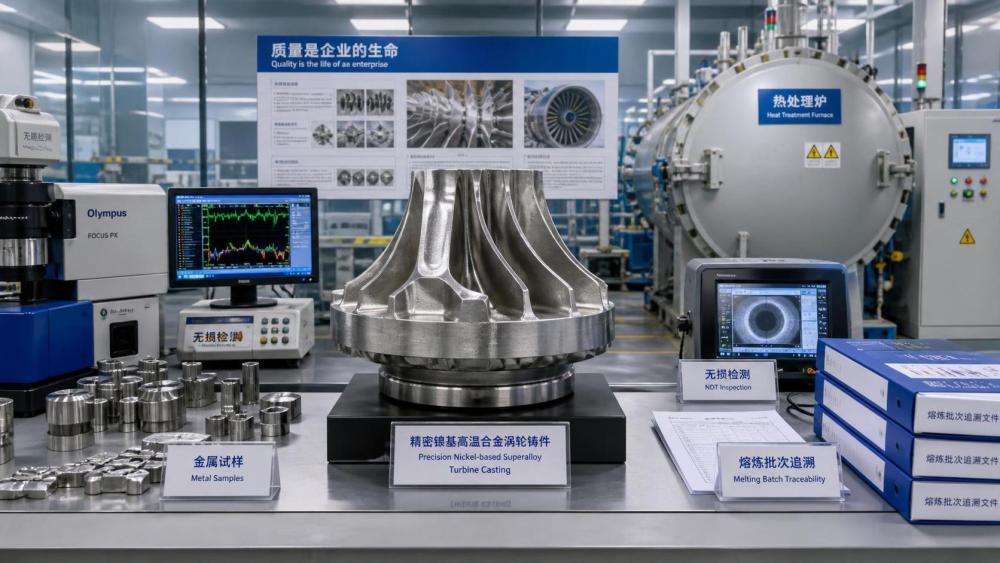
It is also necessary to distinguish Nadcap from a casting qualification. Nadcap validates compliance with an audited process checklist within an approved scope. It does not automatically approve a supplier for every aerospace casting program. Engine, airframe, defense, and space customers can impose their own source approvals, process specifications, or proprietary audit requirements beyond Nadcap.
ISO/IEC 17025: laboratory competence, not foundry approval
ISO/IEC 17025 accreditation is often one of the most valuable supporting credentials when material verification drives acceptance risk. It applies to testing and calibration laboratories, not to a foundry’s overall production system.
A casting supplier may operate an ISO/IEC 17025-accredited laboratory internally, or it may send tensile testing, chemical analysis, metallography, fracture examination, and dimensional calibration to accredited external providers. The useful question is not simply whether “the lab is accredited,” but whether its accredited scope covers the specific method required.
For example, a laboratory may be accredited for selected chemical-analysis techniques without being accredited for high-temperature tensile testing, creep testing, low-cycle fatigue, or a specific metallographic method. Similarly, calibration accreditation does not establish competence for destructive mechanical testing. The certificate scope and the current accreditation schedule are more informative than the logo on a test report.
Personnel certification and NDT authorization need separate scrutiny
Radiography and penetrant inspection can determine whether a casting is accepted, reworked, or rejected. The competence of the people who establish technique, interpret indications, and authorize results therefore matters directly.
In North American aerospace supply chains, NDT personnel are commonly qualified and certified by their employer in accordance with NAS 410. EN 4179 serves a corresponding role in European aerospace contexts. These frameworks set aerospace-specific expectations for training, experience, examinations, vision requirements, and certification administration.
A general NDT credential, including certification under other industry schemes, may be useful evidence of individual competence but is not automatically interchangeable with employer-based aerospace authorization. The supplier should be able to provide its written practice, current personnel authorization records, applicable method levels, and evidence that the inspection technique matches the customer’s specification.
The same principle applies to welding repair, heat-treatment operation, and laboratory testing. A certificate issued to an individual does not replace documented process qualification, equipment control, and part-specific authorization.
Standards compliance is not the same as certification
Castings are often produced to documents such as AMS, ASTM, ASME, military specifications, OEM specifications, and drawing notes. These documents define requirements for alloy chemistry, mechanical properties, melting practice, heat treatment, inspection, grain size, porosity acceptance, repair limits, and documentation. Compliance with them is fundamental, but a material specification is not itself a supplier certification.
A mill certificate, chemical report, certificate of conformance, or test report can show compliance for a specific heat, lot, or delivery. It does not establish that the supplier has a robust aerospace quality system. Conversely, AS9100 certification does not prove that every shipment conforms to a particular AMS requirement.
The practical evidence chain is therefore cumulative: the management system governs the operation; approved processes control manufacturing; inspection and testing establish conformance; traceability connects the finished casting to its melt, process history, and records.
Customer approval often outweighs generic certification
For flight-critical parts, a buyer may require the foundry to appear on an approved supplier list, hold a direct OEM source approval, or be qualified under a program-specific process specification. This can be more decisive than a broad certification portfolio because approval is linked to the customer’s own technical requirements, audit criteria, and part risk classification.
A supplier can hold AS9100 and relevant Nadcap accreditations yet still lack approval for a particular turbine-engine alloy, structural casting family, or controlled repair process. Equally, an established program-approved source may be indispensable for continuity even if an alternative supplier presents impressive generic certificates.
Approval status should be verified directly with the customer-controlled list or through authorized program documentation. A supplier’s presentation stating that it “serves aerospace” is not equivalent to current approval for the intended application.
What documents establish credible casting capability
Certification review is most effective when paired with a part-specific evidence request. The necessary package varies by component, but an aerospace casting source should be able to connect its certificates to actual production controls. Relevant records commonly include:
- current AS9100, EN 9100, or JIS Q 9100 certificate, including site address and certified scope;
- current Nadcap certificates and scopes for in-house special processes, plus approval evidence for outsourced processes;
- melt, heat, and lot traceability from incoming charge materials through final shipment;
- material test reports covering chemistry, mechanical properties, and heat-treatment condition where required;
- process qualification records for the casting method, tooling, shell or mold system, melting route, and heat treatment;
- NDT procedures, technique sheets, personnel authorizations, and acceptance records;
- repair procedures and customer authorization when weld repair or other repair methods are permitted;
- first article inspection documentation, often prepared to AS9102 when contractually required;
- nonconformance, concession, and change-control procedures; and
- program-specific customer approval or source-list evidence.
AS9102 deserves careful treatment. It is widely used for first article inspection reporting, but it is not a certification of the supplier or the casting process. It provides a structured way to demonstrate that the first production article matches drawing characteristics, material requirements, and accountable manufacturing records.
Credentials that are commonly overstated
Several documents are relevant to aerospace business but do not independently validate aerospace-grade casting capability. FAA or EASA approvals, for example, may apply to production approval holders, maintenance organizations, or regulated aviation activities. Their relevance depends on the supplier’s legal role and the article being produced; they should not be assumed to certify a foundry’s metallurgical process.
Export-control registrations, including ITAR registration in the United States, address regulatory obligations and controlled technical data. They do not certify quality or casting performance. ISO 14001 and ISO 45001 indicate environmental or occupational health and safety management, respectively, but do not establish aerospace manufacturing conformance.
These credentials may be necessary within a sourcing decision, especially in defense-related supply chains, but they answer different questions from the one posed by aerospace casting qualification.
The decision rule: match each certificate to the risk it controls
The strongest supplier assessment does not ask which certificate looks most prestigious. It asks which risk each credential actually controls. AS9100 addresses the aerospace quality-management framework. Nadcap addresses selected special-process discipline. ISO/IEC 17025 supports laboratory competence within a defined scope. NAS 410 or EN 4179 supports aerospace NDT personnel authorization. Customer approval confirms alignment with a specific program.
No single certification can verify every aspect of aerospace-grade metal casting capability. The credible supplier is the one that can demonstrate an unbroken link between its certified systems, approved processes, traceable material records, qualified inspections, and the exact technical requirements of the casting being sourced.
Related News
- Nickel-Cerium Alloy Selection Criteria for High-Temperature Aerospace ComponentsSep 11, 2026Nickel cerium alloys boost thermal stability & oxidation resistance in jet engine hot sections—discover key selection criteria for aerospace reliability.
- Alloy Characterization Methods: Choosing Tests for Aerospace Material QualificationSep 11, 2026Alloy characterization methods for aerospace qualification: select chemistry, microstructure, mechanical, NDT, and environmental tests that prove service-ready performance.
- Non-Ferrous Alloy Applications: Matching Materials to Aerospace, EV, and Marine LoadsSep 10, 2026Non-ferrous alloy applications for aerospace, EV, and marine loads: compare aluminum, titanium, nickel, copper, and magnesium for durable, verified material choices.
- Which Corrosion Resistance Standards Apply to Aerospace Metals and Coatings?Sep 09, 2026Corrosion resistance standards for aerospace metals and coatings: compare ASTM, MIL, ISO, and qualification requirements for reliable, compliant performance.