
EV aluminum casting suppliers should hold quality-system certifications appropriate to their place in the automotive supply chain, supported by evidence that their casting processes and material testing meet the component’s requirements. For automotive production programs, IATF 16949 is a central supplier qualification criterion where the customer requires it. ISO 9001 provides a broader quality-management foundation, while ISO/IEC 17025 accreditation can establish confidence in the laboratories performing critical tests.
No single “metallurgy certificate” proves that a supplier can manufacture a reliable battery housing, motor housing, or structural casting. Buyers need to separate three questions: Is the manufacturing site’s quality system acceptable? Are its processes controlled for the intended application? Has the specific part been validated and approved? A supplier can answer the first question convincingly and still fall short on the other two.
Which certifications belong on the supplier shortlist?
A useful shortlist begins with the customer’s contractual requirements and the casting’s function. A bracket with limited structural responsibility and a crash-relevant body casting need different levels of supporting evidence, even if both come from an IATF-certified plant.
- IATF 16949: An automotive quality-management certification to prioritize when required by the vehicle manufacturer or direct customer. Verify that the relevant manufacturing site and activities are covered.
- ISO 9001: A general quality-management certification that can support initial qualification, development work, or supply arrangements where the customer accepts it. It does not replace an explicit IATF 16949 requirement.
- ISO/IEC 17025: Laboratory accreditation relevant to material and performance testing. Check the accredited scope for the actual test methods being used.
- Customer-specific process approvals: Evidence that the supplier meets the purchasing organization’s requirements for casting, heat treatment, inspection, traceability, and production approval.
ISO 14001 and ISO 45001 may also matter to the buyer’s environmental and occupational-safety qualification process. They address different management responsibilities and should not be treated as evidence of alloy quality, casting integrity, or mechanical performance.
Is IATF 16949 mandatory for every EV aluminum casting supplier?
IATF 16949 is not a universal legal requirement for every company producing aluminum parts for electric vehicles. Its necessity depends on the customer, the supply-chain position, the manufacturing activities, and the applicable supplier-development requirements. For a production casting entering an automotive program, buyers should establish the required certification status before awarding business.
The standard addresses automotive quality management, including defect prevention, variation reduction, and requirements that support consistent production. Certification provides evidence that an organization’s system has been assessed against those requirements. It does not certify a particular aluminum alloy or demonstrate that an individual casting meets its drawing.
An ISO 9001-certified supplier may be acceptable for prototype castings or another explicitly approved supply arrangement. That acceptance should be documented. A promise to obtain IATF certification later creates a qualification dependency that can affect production timing; the buyer needs agreed milestones and a clear response if they are missed.
Check the site behind the certificate. A group-level presentation showing an automotive certificate is insufficient if the proposed parts will be produced at another foundry. Where casting, machining, and other operations occur at different locations, establish which sites are covered and how the complete manufacturing route is controlled.
What does laboratory accreditation prove about metallurgy?
ISO/IEC 17025 accreditation concerns a laboratory’s competence to perform activities within its accredited scope. For EV aluminum castings, relevant testing may include chemical composition, tensile properties, hardness, or other specified material characteristics. The useful question is whether the laboratory is accredited for the methods needed to verify the purchase specification.
A laboratory accredited for chemical analysis is not automatically accredited for fatigue testing, computed tomography, or every mechanical test. Read the scope rather than relying on an accreditation logo. Where testing is outsourced, identify the laboratory that will perform the work and verify its scope directly.
Sampling deserves equal attention. A tensile specimen cast separately from the production component may experience a different cooling history and develop a different microstructure. Its results may be valid for an agreed test requirement, but they do not automatically establish the properties of a thick junction or critical load path in the actual part.
For demanding applications, the drawing or qualification plan should define specimen location, orientation, material condition, and acceptance criteria. Test reports should identify the method, sample, results, and connection to the relevant production lot. Accredited testing adds confidence to the measurement; representative sampling determines how much that measurement says about the casting.
Are casting and heat-treatment assessments certifications?
Process assessments can be important without being independent management-system certifications. AIAG’s CQI-27 Casting System Assessment and CQI-9 Heat Treat System Assessment are examples of frameworks that automotive customers may require. Their applicability comes from the customer’s requirements and the operations involved.
A statement that a supplier is “CQI certified” needs clarification. Ask which assessment was completed, which site and processes it covered, who performed it, and whether findings were closed. An assessment report with unresolved weaknesses offers a different level of assurance from a completed assessment supported by effective corrective action.
For aluminum casting, the supporting evidence should address controls appropriate to the process: alloy identification, melt handling, contamination control, tooling condition, process parameters, and defect evaluation. For high-pressure die casting, vacuum performance and shot-process control may be significant. Other casting methods require controls suited to their own failure mechanisms.
If the part receives heat treatment, qualification should cover the specified thermal cycle, furnace controls, temperature measurement, loading practices, and quenching where applicable. Some structural aluminum casting alloys are designed for use without subsequent heat treatment. In those cases, requiring heat-treatment credentials contributes little to qualification; the buyer should focus on the controls that establish the required as-cast properties.
Do EV suppliers need Nadcap or other specialized approvals?
Nadcap accreditation is associated with special processes in aerospace and other demanding supply chains. It should not be added automatically to an EV casting specification simply because the component is safety-relevant or the supplier also serves aerospace customers.
Require it when the contract or customer expressly calls for an applicable accredited process. If a supplier presents Nadcap accreditation as an additional credential, verify the process and site covered. Accreditation for one activity does not demonstrate capability across casting, heat treatment, inspection, and finishing.
Personnel qualifications can also matter. Radiographic testing or other nondestructive testing may require personnel qualified under a scheme specified by the customer or applicable standard. Buyers should check the technique, qualification level, authorization, and inspection procedure relevant to the work.
Neither an aerospace credential nor an inspector’s qualification establishes acceptance criteria for an EV component. The engineering specification must define which defects matter, where they matter, and how they will be evaluated. Qualified personnel need a suitable procedure and clear limits to make consistent acceptance decisions.
How should requirements differ for battery housings and structural castings?
The certification baseline may be similar, but the evidence needed for part approval changes with the failure consequence. Procurement teams should involve design and quality engineers early enough to translate those consequences into supplier requirements.
Battery housings: Where a casting forms part of a sealed enclosure or contains cooling passages, leak performance deserves particular attention. Define the test method, pressure conditions, acceptance limit, and production-test coverage. Porosity near sealing surfaces, dimensional stability after machining, and compatibility with coatings or joining processes may affect acceptance. A sound quality system cannot compensate for a leak test that does not represent the specified operating conditions.
Structural and large body castings: Qualification should connect material properties and defect limits to the load paths and joining interfaces identified by engineering. Depending on the design, this can require location-specific mechanical testing, dimensional verification, and inspection of designated critical regions. The inspection plan should explain how internal defects will be detected and which indications require rejection or further evaluation.
Motor and drivetrain housings: Bearing locations, sealing surfaces, alignment, and stability through machining may dominate the qualification plan. Material verification still matters, but casting certificates alone cannot establish the capability of the finished dimensions.
The buyer should also establish whether weld repair, impregnation, or other salvage operations are permitted. These processes can change a component’s condition and must follow the customer’s approval rules, especially in structural or sealed applications.
How can buyers verify a supplier’s claims before nomination?
Request evidence for the proposed production route, including outsourced operations. A concise verification sequence helps prevent credentials from one site or process being used to support another.
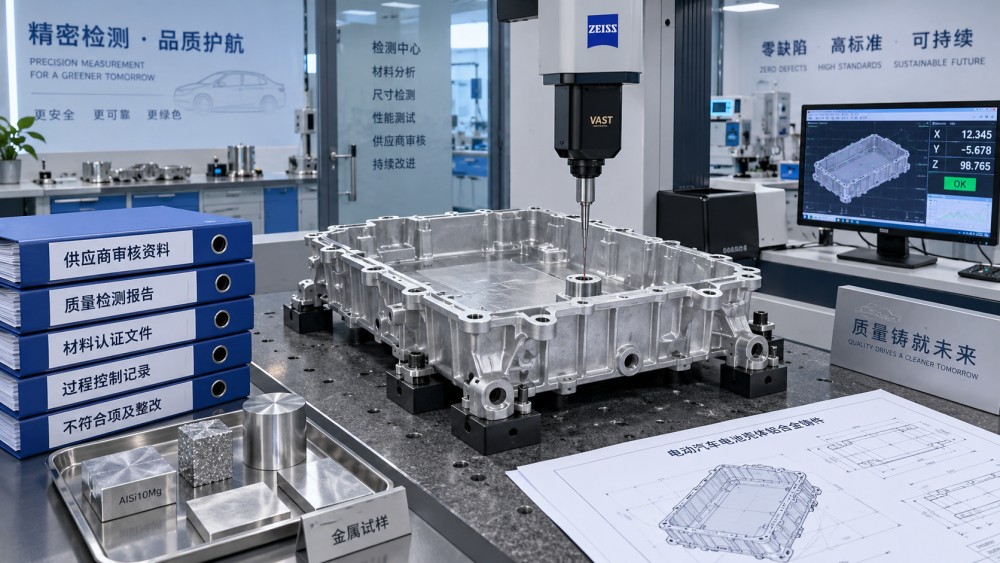
- Match the certificate to the manufacturing site. Check the legal entity, address, scope, certificate identifier, issuing body, and validity information.
- Check certification or accreditation status. Use the relevant issuing body or recognized verification channel where available. Investigate mismatches in names, locations, or activities.
- Map the production route. Identify where casting, heat treatment, machining, finishing, and testing will occur, including approved subcontractors.
- Review relevant process evidence. Examine required assessments, significant findings, corrective actions, and controls for the component’s critical characteristics.
- Confirm part-approval requirements. Establish the required Production Part Approval Process documentation, testing, submission level, and customer acceptance before production release.
PPAP is a production-part approval process, not a general supplier certification. Its value comes from the evidence that the proposed production process can meet the specified requirements. The submission should align with the actual tooling, material, equipment, process route, and production location.
Documented change control is equally important. Changes to alloy source, tooling, process conditions, heat-treatment route, manufacturing site, or subcontractor may require customer notification and approval. The supplier’s system should identify which changes trigger review before altered parts are shipped.
What material records should accompany an acceptable supplier?
Certificates become more useful when supported by traceable production records. Buyers should request a material-reporting and traceability arrangement proportionate to the application, covering alloy identity, specified chemistry, relevant mechanical properties, and any required heat-treatment condition.
The records need a clear connection to the delivered parts. Depending on the agreed system, that link may run through melt batches, casting lots, heat-treatment batches, and finished-part identification. Traceability should allow the supplier to define an affected population if a material or process problem is discovered.
An EN 10204 inspection document may be requested contractually, including a type 3.1 document where appropriate. Such documentation reports compliance and test information under its defined requirements; it does not certify the foundry’s overall capability. A generic certificate of conformity likewise offers limited assurance when the purchase specification requires lot-specific test results.
Before nomination, put three requirements in writing: the acceptable certification status for each relevant site, the process and material evidence needed for part approval, and the records required with ongoing deliveries. A supplier that can connect those requirements to the actual casting route gives the buyer a firmer basis for approval than a long list of credentials with unclear scope.
Related News
- Fatigue Crack Growth in Alloys: How Load Ratio Affects da/dN–ΔK CurvesOct 27, 2026Explore fatigue crack growth alloys exhibit at different load ratios. Learn how closure, thresholds, and da/dN–ΔK curves inform smarter material comparisons and design decisions.
- Surface Engineering: How Coatings and Treatments Reduce Metal WearOct 23, 2026Explore how surface engineering reduces metal wear. Compare coatings, nitriding, and carburizing to choose treatments that improve durability and match real operating conditions.
- Precision Casting Surface Finish: Achievable Ra Values and Process LimitsOct 21, 2026Precision casting surface finish explained: explore achievable Ra values, process limits, and finishing options to specify smarter, control costs, and evaluate supplier claims.
- What Certifications Should EV Aluminum Casting Suppliers Hold?Oct 19, 2026What metallurgy certifications should EV aluminum casting suppliers hold? Explore IATF 16949, ISO 9001, and lab accreditation to verify quality, reduce sourcing risks, and choose with confidence.