
Why does defense metallurgy titanium procurement demand more than a basic alloy callout?
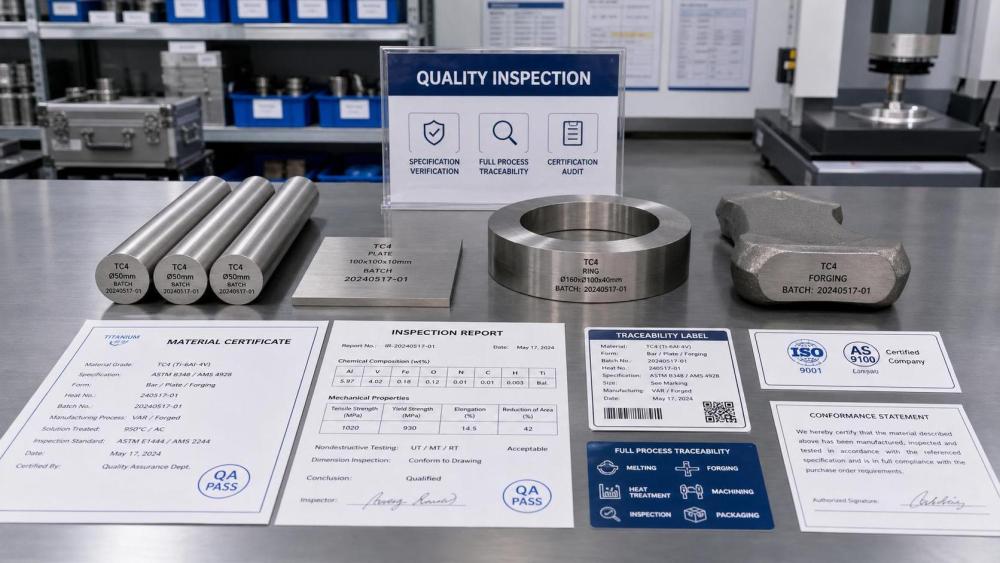
In defense metallurgy titanium sourcing, the part number rarely tells the full story.
A titanium bar, plate, forging, or tube may match a nominal grade, yet still fail audit, performance, or origin checks.
That is why defense metallurgy titanium decisions usually begin with documentation discipline, not price alone.
The practical concern is simple.
Small gaps in heat records, melt source data, or process certification can create large downstream risk.
Those risks include shipment rejection, qualification delay, retesting cost, and uncertain in-service reliability.
More commonly, the issue is not fake material.
It is incomplete evidence around genuine material.
For advanced alloy markets, this is where procurement becomes a metallurgy and compliance exercise at the same time.
Platforms such as AAMS are useful because they frame titanium not as an isolated product, but within broader alloy systems, process control, certification readiness, and supply chain resilience.
That broader view matters when defense metallurgy titanium orders intersect with aerospace standards, specialty processing routes, and export-sensitive material flows.
Which titanium specifications should be checked before comparing quotes?
A quote comparison is only meaningful after the technical basis is fixed.
Otherwise, lower price often reflects a lighter compliance burden, not better procurement value.
The first check is alloy designation.
For defense metallurgy titanium, common materials include commercially pure titanium, Ti-6Al-4V, Ti-6Al-4V ELI, and other application-specific grades.
The second check is product form.
Plate, billet, seamless tube, wire, and forging stock may follow different process routes, test methods, and acceptance criteria.
Then review the governing standard.
That may include ASTM, AMS, MIL, drawing-specific notes, or internal quality clauses tied to mission-critical use.
In practice, these points should be locked before RFQ release:
- Material grade and chemistry range
- Mechanical property requirements by condition
- Heat treatment condition and processing route
- Ultrasonic, surface, or dimensional inspection level
- Required certification package and record retention period
- Traceability expectations down to heat, lot, or melt
A frequent mistake is assuming titanium grade alone defines interchangeability.
It does not.
A forging-quality billet with full pedigree is not equivalent to general industrial stock, even if chemistry looks similar.
The same principle appears across advanced materials markets covered by AAMS, from superalloys to powder metallurgy feedstock.
Specification context changes commercial meaning.
How much traceability is enough in defense metallurgy titanium supply?
The short answer is: enough to reconstruct the material story without guesswork.
For defense metallurgy titanium, traceability should connect received material to melt source, processing history, test evidence, and shipment identity.
That chain often begins with heat number, but should not end there.
Useful traceability usually includes melt method, remelt sequence if relevant, mill source, conversion route, heat treatment batch, inspection lot, and final marking.
When any link is vague, risk increases.
For example, relabeled stock from mixed inventory can create document continuity problems even when physical material appears acceptable.
The table below helps separate routine paperwork from decision-critical evidence.
In real sourcing work, enough traceability means the records can survive internal review and external audit.
If they only support receiving inspection, they may still be too weak.
What should be inside the certification package, and what is often missing?
Many teams ask for a mill cert, then discover later that one certificate was never enough.
For defense metallurgy titanium, the certification package should match both material risk and end-use exposure.
At minimum, expect material test reports, specification references, product form details, dimensions, quantity, heat identity, and signed compliance statements.
Depending on the program, additional records may include ultrasonic inspection results, hardness data, heat treatment logs, macroetch review, or source inspection release.
A few gaps appear again and again:
- Certificate references an outdated standard revision
- Chemistry results are shown, but not actual mechanical test values
- Distributor declaration is provided without original mill certificate
- Heat treatment is stated, but furnace or batch trace is absent
- Test location or accrediting status is unclear
These omissions matter because titanium properties are process-sensitive.
The alloy chemistry can be correct while the conditioning route is still unsuitable.
That concern is familiar across high-performance metallurgy, especially where fatigue, fracture toughness, or thermal exposure are critical.
AAMS often treats this as a system question.
Certification quality is not a paperwork side issue.
It is evidence that the manufacturing route remained under control.
When two suppliers offer the same grade, how do you judge the real difference?
This is where defense metallurgy titanium procurement becomes a comparison of risk profiles.
Two suppliers may both quote Ti-6Al-4V, yet differ sharply in manufacturability, lead-time reliability, and audit support.
More useful than headline price is a side-by-side review of capability signals.
Look at these points together:
- Primary mill status or dependence on outside conversion partners
- History with aerospace or defense-grade titanium forms
- Consistency of document package across previous lots
- Ability to support retest, reissue, or root-cause follow-up
- Transparency on scrap policy, remelt practice, and subcontract processing
- Capacity stability during commodity disruptions
Cost should be interpreted through this lens.
A lower offer can become expensive if incoming inspection expands, qualification slips, or alternate sourcing is needed after a cert dispute.
In actual supply chains, the cheapest defense metallurgy titanium is often the material with the lowest total verification burden.
That distinction matters even more when titanium competes internally with nickel alloys, specialty steels, or lightweight aluminum systems for program allocation.
Cross-material intelligence improves sourcing decisions because it clarifies where performance truly requires titanium and where it does not.
What risks usually disrupt cost and lead time in defense metallurgy titanium orders?
The obvious risk is market pricing for sponge, billet, or forged input.
But procurement disruption often starts elsewhere.
Documentation correction cycles can add weeks.
Source approval restrictions can narrow available mills.
Special testing, export review, and subcontract bottlenecks can also move delivery dates.
Another common issue is buying too late in the process.
Defense metallurgy titanium often needs longer planning windows than standard industrial material, especially for larger sections or custom conversion work.
Need-to-watch risk signals include:
- Quote validity shorter than internal approval cycle
- Unclear reservation of melt capacity
- Long gap between production and certification release
- Frequent substitution language in terms and conditions
- No clear escalation path for traceability disputes
This is where an intelligence-led approach helps.
AAMS covers not only materials science, but also commodity risk, processing capability, compliance signals, and supplier visibility.
That combination is useful when the challenge is not choosing titanium in theory, but managing titanium supply in commercial reality.
What is a practical next-step checklist before placing a defense metallurgy titanium order?
A good order package removes avoidable interpretation before material ships.
That is usually the fastest way to reduce later cost.
Before release, confirm the specification stack, required cert set, traceability depth, approved process route, and receiving inspection plan.
Also check whether internal teams have aligned on acceptable equivalents, retest authority, and document retention rules.
A concise working checklist looks like this:
- Freeze alloy, form, condition, and standard revision
- Define mandatory origin and chain-of-custody records
- Require original mill certification, not summary statements alone
- Match testing scope to application criticality
- Review lead time against approval, inspection, and contingency windows
- Keep a documented comparison log for supplier decisions
The central lesson is straightforward.
Defense metallurgy titanium procurement is not secured by alloy name alone.
It is secured by evidence quality, process clarity, and sourcing decisions that stand up under review.
The next move is to turn these checks into a repeatable internal standard.
That makes supplier comparison faster, traceability stronger, and future titanium orders easier to defend on cost, compliance, and performance.
Related News
- Nickel-Cerium Alloy Selection Criteria for High-Temperature Aerospace ComponentsSep 11, 2026Nickel cerium alloys boost thermal stability & oxidation resistance in jet engine hot sections—discover key selection criteria for aerospace reliability.
- Alloy Characterization Methods: Choosing Tests for Aerospace Material QualificationSep 11, 2026Alloy characterization methods for aerospace qualification: select chemistry, microstructure, mechanical, NDT, and environmental tests that prove service-ready performance.
- Non-Ferrous Alloy Applications: Matching Materials to Aerospace, EV, and Marine LoadsSep 10, 2026Non-ferrous alloy applications for aerospace, EV, and marine loads: compare aluminum, titanium, nickel, copper, and magnesium for durable, verified material choices.
- Which Corrosion Resistance Standards Apply to Aerospace Metals and Coatings?Sep 09, 2026Corrosion resistance standards for aerospace metals and coatings: compare ASTM, MIL, ISO, and qualification requirements for reliable, compliant performance.