
How Can You Verify an Aerospace-Grade Metal Recycling Supplier?
Aerospace scrap is not simply “high-value metal.” A container of titanium turnings, a pallet of nickel-based superalloy offcuts, or a batch of aluminum machining chips can carry meaningful recovery value, but only if its identity, condition, and handling history remain credible. Once alloy families are mixed, contaminated with cutting fluids, or separated from their production records, the value can fall quickly. In some cases, the material may no longer be suitable for the recycling route originally planned.
That is why the question is not just whether a recycler offers a competitive price. The more useful question is: how to verify if a metal recycling supplier meets aerospace scrap standards? The answer involves technical controls, commercial discipline, environmental compliance, and a realistic understanding of what the recycler can actually process rather than merely collect.
For procurement teams handling titanium, Inconel-type nickel alloys, cobalt-bearing superalloys, high-strength steels, aluminum aerospace grades, or copper alloys, verification should begin before the first truck arrives. The strongest recycling relationships are built around documented material streams, agreed inspection rules, and clear consequences when a load does not match its declared grade.
Start with the scrap stream, not the supplier brochure
A supplier cannot be evaluated in the abstract. A recycler that handles clean aluminum extrusion scrap well may not have the segregation discipline needed for titanium 6Al-4V machining turnings. Likewise, a company experienced in bulk stainless steel may not be set up to preserve the identity of nickel superalloy revert intended for a controlled remelt program.
Before requesting quotations, define what is actually leaving the plant. Separate solids from turnings, mixed fabrication scrap from certified production offcuts, and clean material from material carrying oil, paint, sealant, blasting media, or embedded foreign objects. “Titanium scrap” is too broad for a serious recycling agreement. The recycler needs to know whether the material is sheet skeleton, bar ends, forging flash, turbine-related revert, powder handling residue, or wet chips from machining.
This distinction affects both safety and metallurgical recovery. Fine titanium chips may require special fire-risk controls. Wet turnings can lose value because of fluid content and oxidation concerns. Nickel alloy scrap may look similar across grades while differing materially in chromium, cobalt, molybdenum, niobium, tungsten, or aluminum content. A buyer should expect the supplier to ask these questions. If they do not, they may be pricing the load as generic mixed scrap rather than as a controlled aerospace-grade feedstock.
Traceability is the first real test
In aerospace recycling, traceability does not mean a vague statement that material is “fully documented.” It means the recycler can connect a received lot to its source, declared alloy, weight, inspection result, storage location, processing steps, and final disposition. The records do not always need to replicate the original mill certificate, but they should make it possible to reconstruct what happened to a load.
Ask to see a sample chain-of-custody record with commercially sensitive details removed. It should show how the supplier assigns lot numbers, how incoming material is photographed or inspected, how discrepancies are recorded, and how processed material remains tied to the original receipt. The paperwork should also distinguish between customer-declared grade and recycler-verified grade. Those are not automatically the same thing.
A practical warning: traceability can be lost inside the recycler’s yard, not only at the generator’s site. A well-labelled drum of machining chips is of little use if it is tipped into a common pile before testing. During an audit or site visit, pay attention to physical segregation: labelled bays, covered containers, controlled access, dedicated bins, and the discipline of the forklift operators. Yard layout often reveals more than a polished quality manual.
Verify alloy identification methods—and understand their limits
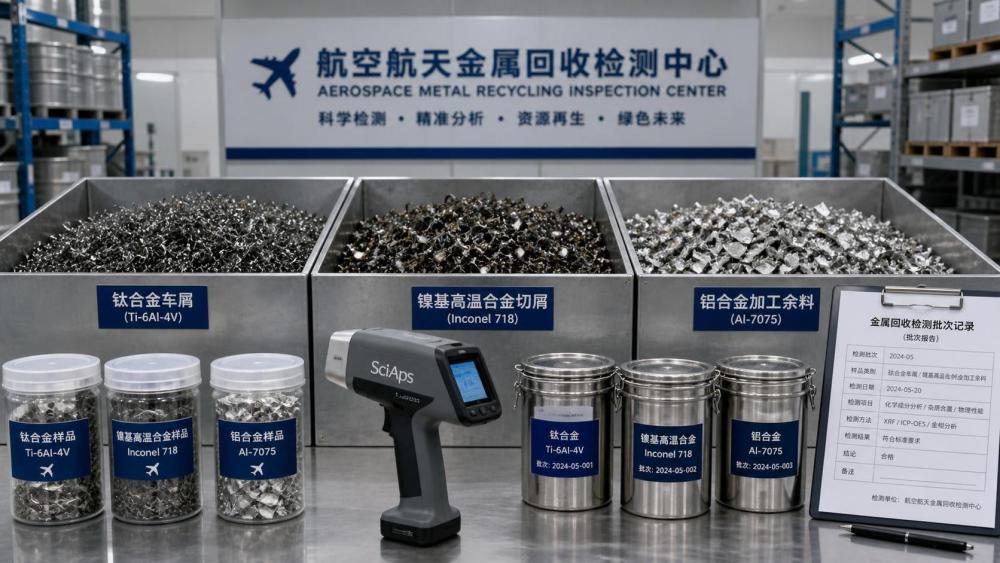
A credible recycler should explain how it verifies material chemistry, not merely say that it uses “advanced testing equipment.” Handheld X-ray fluorescence, commonly called XRF, can be useful for rapid sorting of many alloy solids. However, it has limitations, particularly for light elements and for materials with coatings, oxidation, irregular surfaces, or contamination. It may help distinguish broad alloy families, but it should not automatically be treated as conclusive proof of every aerospace grade.
Optical emission spectrometry may be more suitable for certain metallic grade-verification tasks, while laboratory methods may be needed where carbon, sulfur, nitrogen, oxygen, hydrogen, or closely controlled alloy additions matter. The correct method depends on the alloy, form, and downstream remelt specification. Titanium is an obvious example: contamination control and interstitial elements can be commercially important, yet not every handheld field test can address them adequately.
The right question is not “Do you have an XRF gun?” Ask:
- Which grades can you positively sort in-house?
- Which elements are outside the reliable scope of your routine method?
- How do you sample turnings, fines, and packed containers?
- When do you send samples to an independent laboratory?
- What happens if test results conflict with the supplier’s declaration?
An experienced supplier will answer with boundaries, not promises of perfect certainty. That is usually a good sign. Aerospace scrap verification is about controlling uncertainty, not pretending it does not exist.
Look for contamination control that matches the material’s end use
Cleanliness requirements should be tied to the intended recycling route. Scrap going to a conventional secondary metal processor may be acceptable with a different contamination profile than revert being prepared for a specialty alloy melt program. Procurement teams should avoid assuming that “recycled” and “closed-loop recycled” mean the same thing.
For aerospace materials, common concerns include mixed alloys, iron pickup in titanium, stainless contamination in nickel streams, excessive cutting fluids, moisture, paint, sealants, plastic labels, abrasives, and foreign metal from fixtures or fasteners. Chips collected from different machining cells can be particularly risky when tool wear, inserts, coolant systems, or operator practices vary.
Certification matters, but it is not a shortcut
Quality and environmental management certifications can provide useful evidence of system discipline, but no certificate alone proves that a company can handle aerospace scrap correctly. ISO 9001 may indicate a documented quality-management structure. ISO 14001 may be relevant to environmental-management practices. Depending on the recycler’s role, local waste permits, transport approvals, safety systems, and downstream processor qualifications may matter just as much.
Aerospace-specific credentials should also be interpreted carefully. A recycler is not automatically required to hold the same approvals as a forging shop, heat-treatment provider, or aircraft component manufacturer. For instance, Nadcap accreditation is relevant to defined special processes and should not be used as a generic badge for any recycling operation. The meaningful question is whether the supplier’s actual scope matches the service they are offering.
Request current certificates, check their stated scope, and ask who performs the audit. Then move beyond the certificate: review nonconformance handling, calibration records for test equipment, training records for material identification personnel, and procedures for quarantine material. A supplier that can explain how it prevents an error is more valuable than one that only displays logos.
Audit the commercial controls as closely as the technical ones
Many disputes in high-value alloy recycling are commercial disputes disguised as quality disputes. The contract should define who determines final grade, how weights are established, what sampling method applies, what moisture or residue deductions may be used, and how long the recycler has to report a discrepancy. These details become especially important for turnings, mixed production scrap, and loads with variable contamination.
It is sensible to agree on rejection or downgrade rules before collection. If a container declared as one nickel alloy contains mixed grades, will it be returned, reclassified, blended into a lower-value stream, or tested at the generator’s cost? If the recycler finds prohibited items, who bears disposal responsibility? Ambiguity creates incentives for both sides to argue after the fact.
Price transparency also deserves attention. Specialty scrap value may reflect alloy chemistry, recoverable metal content, processing cost, logistics, and the recycler’s access to qualified downstream consumers. The highest headline offer is not always the best result if deductions are unclear or settlement reports are difficult to reconcile. A clear settlement statement, tied to lot numbers and agreed testing logic, is usually worth more than an aggressive initial quotation.
Check downstream destination and circularity claims
Buyers increasingly want to know where aerospace scrap goes after collection. This is reasonable, especially when sustainability reporting, export restrictions, defense supply-chain sensitivity, or internal circular-material targets are involved. Still, “closed loop” should not be accepted as a casual marketing phrase. Ask whether the supplier can identify the general downstream route: alloy remelt, secondary processing, metal recovery, or another approved outlet.
Some commercial relationships will limit disclosure of end customers, and that can be legitimate. Even so, the recycler should be able to provide enough evidence to support the claimed route without exposing confidential contracts. This might include downstream qualification criteria, certificates of recycling or destruction where appropriate, shipment records, or mass-balance documentation. The level of proof should match the risk and the claim being made.
Global Advanced Alloys & Metallurgy Systems (AAMS) approaches this subject as part of a wider circular metallurgy picture. The value of recovered metal is linked not only to commodity pricing, but also to alloy design, fatigue requirements, melt practice, traceability expectations, and supply-chain resilience. That perspective is useful because titanium, superalloys, aluminum, copper, carbide-related materials, and rare-earth-containing streams do not share the same recovery constraints.
Use a pilot load before committing volume
A site audit and document review are necessary, but a controlled pilot load often exposes the practical gaps. Start with one clearly identified stream and document it carefully at the point of generation. Record container weights, photographs, alloy designation, condition, and expected contaminants. Compare that information with the recycler’s receiving report, test results, deductions, processing records, and settlement statement.
The objective is not to catch the supplier out over a minor variance. It is to test whether both organizations can handle exceptions without losing the material’s identity or turning every discrepancy into a commercial conflict. If the pilot reveals weak lab methods, unclear storage practice, unexplained weight loss, or inconsistent paperwork, resolve those issues before expanding the program.
The best aerospace recycling supplier is rarely the one with the broadest claim. It is the one that can define its processing limits, preserve segregation, produce auditable records, and give a technically defensible answer when a load is uncertain. For high-value aerospace alloys, that level of discipline is not an extra service. It is what protects the recoverable value of the material in the first place.
Related News
- Nickel-Cerium Alloy Selection Criteria for High-Temperature Aerospace ComponentsSep 11, 2026Nickel cerium alloys boost thermal stability & oxidation resistance in jet engine hot sections—discover key selection criteria for aerospace reliability.
- Alloy Characterization Methods: Choosing Tests for Aerospace Material QualificationSep 11, 2026Alloy characterization methods for aerospace qualification: select chemistry, microstructure, mechanical, NDT, and environmental tests that prove service-ready performance.
- Non-Ferrous Alloy Applications: Matching Materials to Aerospace, EV, and Marine LoadsSep 10, 2026Non-ferrous alloy applications for aerospace, EV, and marine loads: compare aluminum, titanium, nickel, copper, and magnesium for durable, verified material choices.
- Which Corrosion Resistance Standards Apply to Aerospace Metals and Coatings?Sep 09, 2026Corrosion resistance standards for aerospace metals and coatings: compare ASTM, MIL, ISO, and qualification requirements for reliable, compliant performance.