What metallurgy certifications should EV aluminum casting suppliers hold? Start with IATF 16949 for automotive quality management, supported by ISO 9001, credible material and process traceability, and a testing system that can produce reliable evidence. For structural castings, battery enclosures, and large Giga-casting parts, certificates alone are not enough: the supplier must also show control of alloy chemistry, melt treatment, porosity, heat treatment, dimensional capability, and change management.
That distinction matters. A casting supplier can present an impressive certificate wall and still be a poor fit for an EV program if it cannot consistently control recycled-metal inputs, die-casting vacuum performance, internal defects, or lot-level records. The right question is not simply “Which certificates do you have?” It is “Which certification and evidence package proves you can make this specific part reliably?”
What Metallurgy Certifications Should EV Aluminum Casting Suppliers Hold?
For most production EV aluminum casting programs, IATF 16949 certification is the central requirement. It is the automotive quality-management standard built on ISO 9001, but with added expectations around defect prevention, product safety, supplier development, traceability, contingency planning, and automotive customer-specific requirements.
An OEM or Tier 1 sourcing a high-pressure die-cast shock tower, subframe node, battery tray, inverter housing, or rear underbody casting will usually treat IATF 16949 as the baseline for serial production. A supplier without it is not necessarily incapable of making a sound prototype casting. It may, however, face a serious qualification barrier once the program moves into production part approval and long-term supply.
ISO 9001 remains relevant. It is often sufficient for tooling shops, prototype foundries, machining subcontractors, low-volume industrial suppliers, or early development work. But ISO 9001 should not be presented as equivalent to IATF 16949 for a high-volume automotive safety-related component. That is a common purchasing mistake.
A practical minimum package usually looks like this:
- IATF 16949: the core automotive quality-management certification for production supply chains.
- ISO 9001: useful as a foundational system and often relevant for suppliers outside full automotive serial production.
- ISO 14001: environmental management, increasingly requested in supplier onboarding and sustainability reviews.
- ISO 45001: occupational health and safety management, particularly relevant in melting, die casting, trimming, and heat-treatment operations.
- ISO/IEC 17025: important where a supplier’s laboratory performs critical chemical, mechanical, or dimensional testing. The scope matters more than the logo.
Not every facility needs every item. A small prototype casting source may reasonably operate under ISO 9001 and use an accredited external laboratory. A supplier quoting structural EV castings for sustained volume should expect far closer scrutiny.
Quality Certification Is Only the Starting Point
Automotive aluminum casting failures rarely come from a missing certificate in isolation. They come from process variation that was not detected early enough. Hydrogen pickup, oxide inclusions, inconsistent return scrap, inadequate degassing, poor die thermal balance, vacuum leakage, unstable shot profiles, and uncontrolled heat treatment can all affect casting integrity.
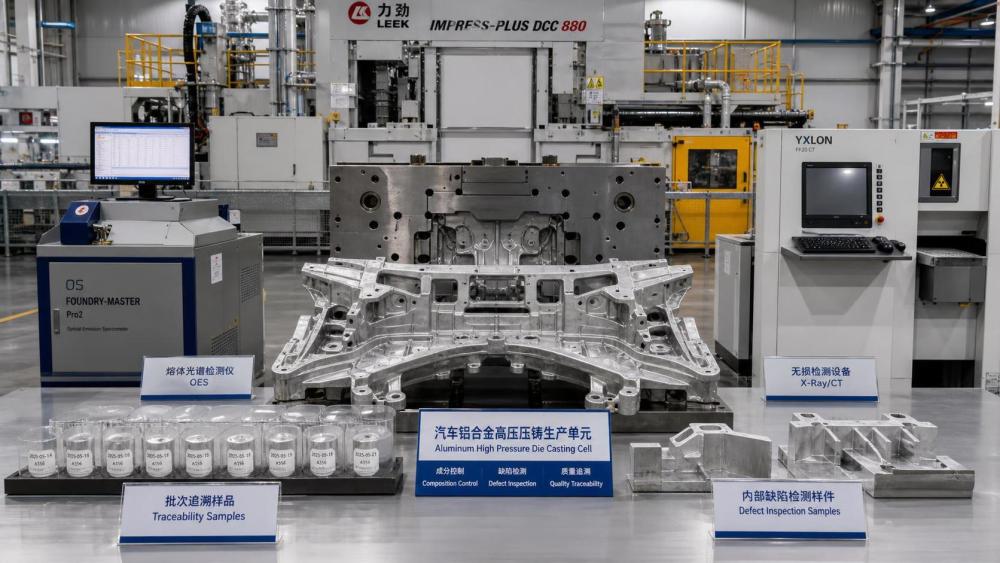
This is why buyers should ask to see process evidence alongside certifications. For high-pressure die casting, that evidence may include melt-temperature control records, alloy spectrometer verification, degassing practice, density-index monitoring where applicable, vacuum-system verification, die-maintenance plans, and defect-response procedures. The exact controls depend on the alloy, part geometry, wall thickness, joining method, and customer specification.
For example, a non-structural electronics housing and a crash-relevant body casting may both use aluminum die casting, but they should not be evaluated with the same depth. Cosmetic appearance and machining quality may dominate the first part. The second may demand stronger evidence on internal soundness, fatigue performance, repair restrictions, and consistency across cavities and production shifts.
Automotive Core Tools Are Not Certifications, but They Are Essential
Many sourcing teams focus on certificate names and overlook the documents that actually show a supplier understands automotive launch discipline. APQP, PPAP, FMEA, control plans, measurement-system analysis, statistical process control, and production-capacity studies are not standalone metallurgy certifications. Still, they are fundamental evidence of automotive readiness.
A supplier should be able to explain how its process FMEA reflects real casting risks. A generic FMEA that lists “porosity” without tying it to melt treatment, vacuum level, injection settings, die temperature, and inspection controls does not give much confidence. The control plan should identify what is measured, how often it is measured, who reacts to an out-of-control signal, and how suspect material is contained.
For a new casting, PPAP evidence commonly becomes the point where a supplier’s claimed capability is tested. Material certificates, dimensional reports, capability data, functional checks, inspection methods, and documented changes all need to align. A passable first-article sample does not prove that the same quality can be maintained after tooling wear, alloy batch changes, or higher production rates.
Material Conformance Must Be Defined by Standard and Part Function
There is no single “EV aluminum certificate” that proves suitability for every component. The casting alloy and acceptance criteria must be defined against the applicable customer drawing, material specification, regional standard, or recognized alloy standard. Depending on the supply chain, references may include EN aluminum casting-alloy standards, ASTM specifications, SAE requirements, or an OEM’s internal material specification.
The certificate of analysis should identify the alloy chemistry and the melt or batch traceability. Yet chemistry alone does not establish structural suitability. Two melts may meet the same nominal chemistry window while delivering different real-world performance because of oxide content, hydrogen level, microstructure, heat treatment, casting parameters, or local defect populations.
Mechanical-property certification needs the same caution. Test-bar values can be useful, but they do not automatically represent the properties in a thick section, a critical junction, or a location affected by filling behavior. When the part is structurally demanding, buyers should clarify where test coupons are taken, which condition is tested, and how the testing relates to the actual casting.
Also ask how the supplier manages secondary aluminum. Recycled content can support environmental objectives, but it changes the importance of incoming-material segregation and chemistry control. The responsible position is not to reject recycled metal by default. It is to require a controlled feedstock strategy and evidence that the required alloy limits are maintained.
Special Process Assessments Deserve Attention
Certification verifies that a management system has been audited. It does not automatically validate every special process on every machine. Casting suppliers often face customer audits or industry assessment requirements for processes such as die casting, heat treatment, coating, machining, and welding.
AIAG CQI assessments are commonly used by automotive supply chains to evaluate special-process management. CQI-27, for example, addresses die casting system assessment. It is not a universal certificate that replaces IATF 16949, and applicability should be confirmed with the customer. Still, a supplier that understands the assessment, maintains current self-assessments, and can close gaps systematically is generally easier to qualify than one that only knows the name.
Heat treatment deserves separate attention. Some aluminum casting alloys are used as-cast, while others rely on a specified thermal cycle to achieve the intended property balance. Where heat treatment is critical, ask for furnace calibration, load control, quench discipline, recipe access controls, and records that connect the heat-treatment batch to the casting lot. An attractive tensile result from one qualification run is not enough.
Nadcap is often raised in metallurgy discussions. It is highly relevant in aerospace special-process supply chains, but it is not normally a blanket requirement for EV aluminum casting suppliers. Requiring it for an ordinary automotive casting can add cost without improving the real risk control. It becomes more relevant only when a customer, program, or adjacent aerospace requirement explicitly calls for it.
Laboratory Competence and NDT: Check the Scope, Not Just the Certificate
ISO/IEC 17025 accreditation can be valuable for a supplier laboratory or third-party test house, especially when chemical analysis, tensile testing, hardness testing, metallography, or dimensional measurement is used for release decisions. Buyers should review the actual accreditation scope. A laboratory accredited for one method or material range should not be assumed to cover every test performed on aluminum castings.
Internal quality often requires X-ray inspection, CT scanning, ultrasonic testing, dye penetrant inspection, or destructive sectioning. These methods serve different purposes. X-ray can reveal many internal discontinuities, but its effectiveness depends on part geometry, inspection settings, image quality, acceptance criteria, and operator competence. CT can provide richer information, but may not be practical for every high-volume part. The correct approach follows the risk of the feature being inspected, not a preference for the most expensive method.
For critical locations, ask a direct question: what defect type is being controlled, what acceptance standard applies, and how was that limit linked to part performance? A vague statement such as “100% X-ray inspected” is weaker than it sounds if the acceptance criteria are undefined.
Environmental and Supply-Chain Credentials Are Becoming Part of the Decision
ISO 14001 is a sensible baseline for demonstrating environmental-management discipline. It does not certify low-carbon aluminum, recycled content, or responsible sourcing by itself. Those claims need their own evidence, often including mass-balance records, supplier declarations, life-cycle data, or customer-approved calculation methods.
For organizations with formal responsible-aluminum or chain-of-custody requirements, Aluminium Stewardship Initiative certification may be relevant. Its value depends on the procurement policy and the material flow involved. It should not be requested as a universal substitute for casting-process control.
Material compliance data also matters. IMDS submission is widely expected in automotive programs, but it is a reporting and material-data requirement, not a metallurgy certification. Suppliers may also need to support declarations related to applicable chemical restrictions and end-of-life vehicle requirements. Because regulatory obligations vary by market and product, the latest customer and official requirements should be checked rather than relying on a generic supplier declaration.
How to Evaluate a Supplier Before Nominating Them
A strong qualification process begins by separating parts into risk levels. A decorative bracket, a battery enclosure, and an integrated structural Giga-casting should not receive identical audit questions. The more the component affects crash performance, sealing, thermal management, electrical isolation, or fatigue life, the more detailed the process review should become.
Request current certificates, then verify the issuing body, facility address, scope, and expiry date. This simple check prevents a surprising number of misunderstandings. A group-level certificate may not cover the plant that will actually produce the part. A certificate for machining may not cover melting and die casting. A certification scope that excludes design may also matter where the supplier is expected to influence tooling or process design.
Next, review a representative process flow from incoming alloy through melting, casting, trimming, heat treatment, machining, inspection, packing, and shipment. Look for traceability breaks. If a defect is discovered after machining, can the supplier identify the melt, die cavity, shift, shot parameters, heat-treatment batch, and downstream lots affected? The answer is far more useful than a broad promise of “full traceability.”
Finally, assess how the supplier handles change. New scrap sources, alternate ingot suppliers, repaired dies, altered release agents, revised thermal cycles, and relocated production can all alter results. Mature suppliers have a documented approval route for these changes and notify customers when required.
FAQ
Is ISO 9001 enough for an EV aluminum casting supplier?
It can be adequate for prototypes, low-volume work, or non-automotive applications. For mainstream automotive serial production, IATF 16949 is usually the expected quality-management baseline.
Does IATF 16949 prove a casting is structurally sound?
No. It demonstrates an automotive quality-management system. Structural soundness still depends on the alloy, casting design, process controls, inspection strategy, validation testing, and ongoing production discipline.
Should every supplier have ISO/IEC 17025 accreditation?
Not necessarily. A supplier can use an accredited external laboratory. What matters is that critical tests are valid, traceable, appropriately scoped, and linked to the part-release plan.
Is Nadcap required for EV Giga-casting?
Usually not. Nadcap is primarily associated with aerospace special processes. Follow the customer specification instead of treating aerospace accreditation as a universal marker of automotive capability.
What is the biggest sourcing mistake?
Equating certificates with capability. The better decision combines verified certifications with a review of alloy control, casting-process evidence, defect criteria, traceability, and change-management history.
When deciding what metallurgy certifications should EV aluminum casting suppliers hold, prioritize IATF 16949 for automotive production, then match laboratory, environmental, responsible-sourcing, and special-process requirements to the actual component risk. Platforms such as Global Advanced Alloys & Metallurgy Systems can help structure that review by connecting certification status with alloy performance, high-pressure die-casting practice, heat treatment, supply-chain resilience, and application-specific technical evidence.
Related News
- Nickel-Cerium Alloy Selection Criteria for High-Temperature Aerospace ComponentsSep 11, 2026Nickel cerium alloys boost thermal stability & oxidation resistance in jet engine hot sections—discover key selection criteria for aerospace reliability.
- Alloy Characterization Methods: Choosing Tests for Aerospace Material QualificationSep 11, 2026Alloy characterization methods for aerospace qualification: select chemistry, microstructure, mechanical, NDT, and environmental tests that prove service-ready performance.
- Non-Ferrous Alloy Applications: Matching Materials to Aerospace, EV, and Marine LoadsSep 10, 2026Non-ferrous alloy applications for aerospace, EV, and marine loads: compare aluminum, titanium, nickel, copper, and magnesium for durable, verified material choices.
- Which Corrosion Resistance Standards Apply to Aerospace Metals and Coatings?Sep 09, 2026Corrosion resistance standards for aerospace metals and coatings: compare ASTM, MIL, ISO, and qualification requirements for reliable, compliant performance.