
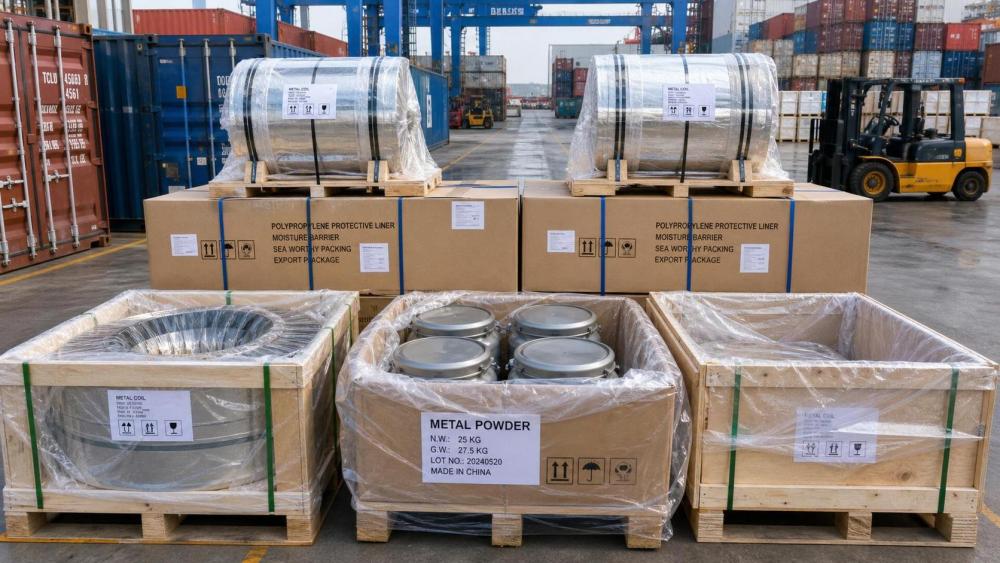
On June 2, 2026, Indonesia’s anti-dumping ruling on Chinese polypropylene homopolymer introduced a trade-rule change that reaches beyond resin pricing and into packaging compliance for metal exports. Because this material is used in moisture- and oxidation-resistant liners and sea-freight pallet packaging for products such as TC4 titanium powder, single-crystal superalloys, and beryllium copper strip, the development deserves attention from exporters, procurement teams, packaging suppliers, and logistics coordinators responsible for customs clearance and delivery continuity.
What the ruling confirms
The confirmed facts are limited but commercially relevant. Indonesia’s anti-dumping authority issued a final determination on June 2, 2026, imposing anti-dumping duties of up to 18.01% on polypropylene homopolymer from China under tariff code 3902.10.40. The material is widely used in protective inner lining and maritime pallet packaging for high-end metal products, including TC4 titanium powder, single-crystal superalloys, and beryllium copper strip. Based on the event summary provided, exporters are advised to assess packaging substitution options or cost pass-through paths in order to reduce the risk that non-compliant packaging auxiliaries could delay customs clearance or lead to shipment return.
Where the pressure may appear across the supply chain
Export shipments tied to protective packaging
From an industry perspective, exporters of aluminum, titanium, and copper alloy products may be affected not because the finished metal product itself is the subject of the tariff, but because a commonly used packaging material sits inside the delivery chain. The immediate area of concern is shipment preparation, especially where anti-moisture and anti-oxidation packaging performance is treated as part of delivery quality and transport protection.
Procurement decisions around auxiliary materials
Procurement teams may need to pay closer attention to whether existing sourcing plans still support cost targets and delivery plans once the duty burden is reflected in packaging inputs. What deserves closer attention is the intersection between material selection, supplier qualification, and documentary consistency, especially where packaging specifications are embedded in purchase requirements or export documentation.
Manufacturing and outbound coordination
For processors and manufacturers shipping high-value metal materials, the issue may surface in the handoff between production, packaging, and logistics. Observably, any change in liner or pallet packaging could require internal review of whether the replacement still aligns with handling, storage, and transport needs. The practical risk is less about headline policy language and more about whether packaging changes create disruption at dispatch or clearance.
Logistics and customs-facing service providers
Supply-chain service providers, including freight and export coordination teams, may need to monitor whether packaging descriptions, tariff-related declarations, and shipment documents remain internally consistent. Analysis shows that even when the core goods are unchanged, packaging auxiliaries can become a compliance checkpoint if the trade rule affects cost structure, sourcing route, or document review during shipment processing.
What companies should review now
Check whether packaging specifications need revision
Companies using polypropylene homopolymer in export packaging should review whether current liner and pallet packaging specifications depend on the affected material. If alternatives are being considered, it is more appropriate to treat this as a compliance and delivery review rather than a simple purchasing swap.
Track documentation tied to packing and shipment
Where packaging materials are referenced in technical documents, shipment records, internal specifications, or customer-facing delivery requirements, those references deserve rechecking. If packaging substitution is pursued, firms should pay attention to whether the related documents remain aligned and usable in export execution.
Reassess cost transfer and contract execution
The event summary specifically points to two practical paths: evaluating replacement materials or considering cost pass-through. Analysis shows that companies should examine how either option may affect quotation logic, delivery commitments, and coordination with buyers, while avoiding assumptions that the market has already settled on one execution model.
Watch for operational signals, not just the headline measure
Because the provided information does not include detailed enforcement language, companies should continue watching for further official wording, execution interpretation, document expectations, and market feedback. This is particularly relevant for shipments where packaging integrity is directly linked to product condition during sea transport.
How this development is best understood
Analysis shows that this is not only a tariff story about a polymer input. It also acts as an execution signal for companies whose export reliability depends on packaging materials that are often treated as secondary inputs. More appropriately, the current development can be understood as a landed rule change with downstream compliance implications, while the exact operational impact still requires observation through procurement choices, shipping practice, and customs-facing documentation.
A practical reading for the metals export trade
A measured interpretation is that the ruling has already created a concrete point of review for exporters using polypropylene homopolymer in protective packaging. The most relevant industry takeaway is not to overstate the policy, but to recognize that packaging auxiliaries can become a trade-compliance variable capable of affecting cost, dispatch rhythm, and border handling. At this stage, it is more appropriate to understand the event as an implemented rule change that also warrants continued monitoring of how it is reflected in day-to-day execution.
Basis of this article and what still needs verification
This article is generated from the user-provided news title, event date, and event summary. For developments of this kind, commonly relevant source types may include official notices, regulatory releases, customs or trade authority information, industry association updates, standard-setting documents, and reporting from established trade media. No specific official source link was provided in the input, so the underlying official publication path still requires further verification. What remains worth monitoring includes any further policy detail, enforcement interpretation, certification or documentation expectations, tender-document adjustments, industry feedback, and actual company-side implementation.
Related News
- Rare Earth Material Sourcing Strategy: Key Criteria for Reducing Supply Chain RiskSep 07, 2026Rare earth material sourcing strategy: reduce supply chain risk with proven criteria for supplier evaluation, quality control, traceability, contracts, and resilient supply.
- How Can You Compare Advanced Alloy Prices Across Regions?Sep 09, 2026How to compare commodity prices for advanced alloys across different regions? Learn to assess landed cost, quality, yield, certification, and supply risk.
- When does commodity exposure management become essential for a growing manufacturer?Sep 04, 2026Commodity exposure management helps growing manufacturers protect margins, stabilize supply, and control risk amid volatile material costs. Learn when to act.
- Which price inputs should be tracked in metals price risk management?Sep 04, 2026Metals price risk management: track benchmarks, premiums, conversion, energy, freight, FX, and supply risks to protect landed costs and strengthen sourcing decisions.