
How Can You Compare Advanced Alloy Prices Across Regions?
A titanium billet quote from one region, a nickel alloy plate offer from another, and a third quotation for finished aerospace bar stock may all appear to describe the same purchasing decision. Usually, they do not. Advanced alloy pricing is shaped by far more than the visible price per kilogram or tonne. Chemistry, melt route, conversion stage, certification package, freight terms, currency exposure, and the supplier’s ability to deliver repeatable material all sit inside the number.
That is why buyers asking how to compare commodity prices for advanced alloys across different regions need a method that goes beyond converting currencies. A lower regional quote can be a genuine sourcing advantage. It can also reflect a different product condition, a narrower inspection scope, a missing processing step, or an assumption that the buyer will absorb risk later in machining, qualification, or delivery.
This matters across titanium alloys, nickel-based superalloys, specialty steels, aluminum extrusions, copper alloys, powder metallurgy products, tungsten carbide, NdFeB magnets, and battery copper foil. Their supply chains are global, but they are not interchangeable commodities in the same way as a standard industrial metal grade. The useful comparison is not “which country is cheapest?” It is “which offer delivers the same usable material, at the same risk level, into our production system?”
Start by Making the Material Basis Identical
The first discipline is simple and frequently skipped: compare like with like. “Inconel-type alloy,” “aerospace titanium,” or “high-strength aluminum” is not enough for a commercial comparison. The purchasing specification should define the exact grade or agreed chemistry range, product form, dimensions, temper or heat-treatment condition, and required test documentation. If any of these vary between quotations, the numbers are not directly comparable.
For example, a nickel-based superalloy can be supplied as vacuum-melted bar, forged stock, plate, powder, or cast preform. Each route has a different cost structure and a different fitness for service. A low quote for as-rolled material may look attractive beside a quote for solution-treated and aged bar, but the downstream processor will still need to carry out the missing work. In aerospace and defense supply chains, that difference may also affect traceability and approval requirements.
The same issue appears in aluminum. An extrusion price may exclude die development, cutting tolerance, aging, surface treatment, packaging, or scrap allowance. A quote for a Giga-cast aluminum component may include casting only, while another includes trimming, heat treatment, inspection, and machining. Neither is automatically misleading; they are simply different commercial scopes.
Before collecting regional prices, build a one-page comparison sheet that fixes the technical baseline:
- alloy designation, chemistry limits, and permitted substitution rules;
- product form, dimensions, tolerance, and delivery condition;
- melt route, forging route, powder route, or casting process where relevant;
- mechanical, chemical, microstructural, and non-destructive testing requirements;
- documentation, traceability, and customer-specific approval expectations;
- packaging, minimum order quantity, and acceptable delivery window.
This document prevents a procurement team from comparing a technically complete offer in one market with a nominal material quote in another. It also makes technical discussions with engineering faster, because deviations are visible before a purchase order is issued.
Separate Metal Value From Conversion Value
Regional price differences often become clearer when an alloy quote is split into its underlying layers. The raw-material portion may be influenced by nickel, cobalt, molybdenum, chromium, titanium sponge, aluminum, copper, tungsten, rare earth feedstock, or other inputs. Yet the conversion portion can be just as consequential for advanced materials.
Conversion includes melting, remelting, atomization, forging, rolling, extrusion, sintering, heat treatment, machining, inspection, yield loss, and quality control. In a high-performance material, these steps are not merely manufacturing overhead. They are part of what the buyer is paying for: cleanliness, consistency, grain structure, fatigue behavior, creep resistance, magnetic performance, conductivity, or dimensional stability.
A useful request to suppliers is a transparent price structure, even if they cannot disclose every internal cost. Ask which elements are subject to a metal surcharge, which are fixed conversion charges, what index or reference date is used, and how long the quotation remains valid. The goal is not to force every supplier into the same accounting format. It is to understand what will move if the market changes.
This is particularly important for products with volatile upstream inputs. Rare earth permanent magnet pricing may be affected by feedstock availability, processing concentration, coating requirements, and magnet grade. Copper foil economics can respond not only to copper input costs but also to foil thickness, surface treatment, defect control, and the production capacity suitable for battery applications. A price change should be traced to a real cost driver before it is treated as a market signal.
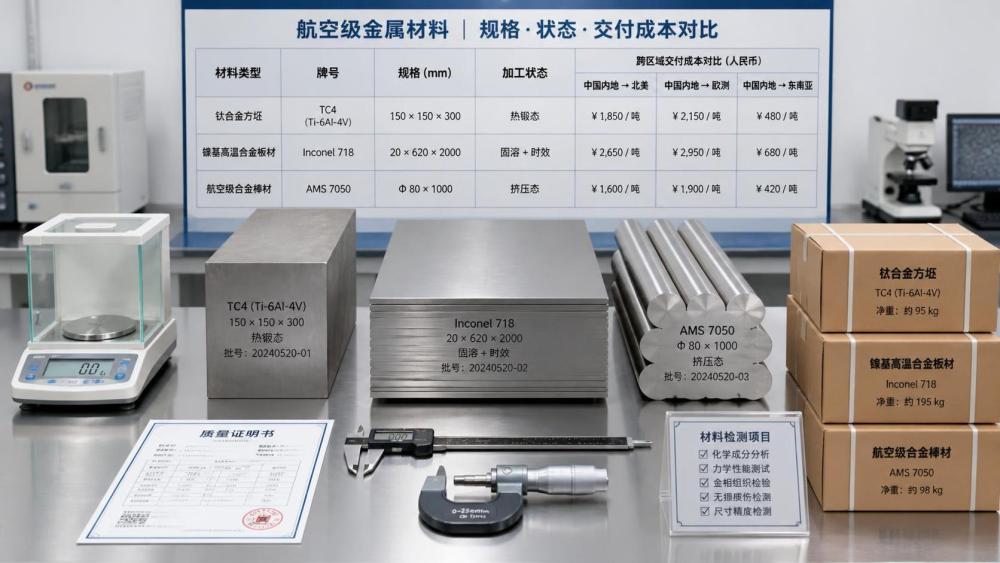
Convert Offers to the Same Delivered Commercial Basis
Currency conversion is necessary, but it is only one part of normalization. A supplier’s ex-works price, a port-based offer, and a delivered-duty-paid quotation cannot be ranked without bringing them to the same commercial basis. Procurement teams often use a landed-cost model for this purpose, with assumptions that are documented and refreshed rather than guessed.
Use a consistent exchange-rate convention. For a spot purchase, the relevant rate may be close to the decision date. For a contract with staged payments or a long production cycle, a planning rate and a sensitivity range are usually more informative. Do not quietly mix the currency rate from one week with freight assumptions from another quarter; that creates false precision.
Regional Advantages Are Usually Process-Specific
It is tempting to assign each region a simple reputation: low cost, premium quality, strong logistics, or reliable supply. In advanced metallurgy, these labels are too broad to guide a purchase. Capability is often concentrated around particular processes and supply ecosystems.
A region with access to primary metal or concentrate may have an advantage in upstream feedstock. Another may be stronger in vacuum melting, precision forging, high-pressure die casting, thin-gauge foil rolling, or carbide tool grinding. A supplier located near an aerospace cluster may be better positioned to support traceability and qualification workflows, while a producer close to automotive assembly may be optimized for repeat-volume aluminum extrusion or cast components.
That is why regional benchmarking should be organized by material and process family, not by geography alone. Compare titanium sponge separately from aerospace-grade titanium mill products. Compare NdFeB magnetic powder, sintered magnets, grain-boundary-diffused magnets, and finished coated assemblies as distinct categories. For cemented carbide, distinguish powder supply, blank production, and finished tool manufacturing. Each stage faces different energy, labor, technology, transport, and qualification pressures.
Specialized intelligence sources such as Global Advanced Alloys & Metallurgy Systems (AAMS) can be useful here because price is only one signal. Technology analysis, supplier visibility, commodity-risk coverage, processing capability, and application context help a buyer understand whether a regional price gap is likely tied to raw materials, available capacity, regulatory exposure, or a different technical scope.
Treat Certification and Traceability as Price Components
For a non-critical industrial application, a standard mill certificate may be sufficient. For flight hardware, turbine components, medical applications, defense-related supply, or safety-critical automotive parts, the documentation burden can be much higher. The required evidence may include heat-level traceability, test records, approved process controls, special-process documentation, or customer-mandated source restrictions. The exact requirement depends on the project and applicable standard.
A quote without the required documentation is not a lower-priced equivalent. It is an incomplete offer. This is especially easy to miss when buyers are comparing material in spreadsheet form and the certificate requirement sits in a separate engineering document.
There is also a practical lead-time issue. A supplier may be technically capable of producing a grade but not have the established test route, approved subcontractor network, or documentation system needed for a particular end use. Qualifying those elements can take longer than making the metal itself. In such cases, a higher-priced regional source with an established delivery record may represent the lower total project risk.
Compare Delivered Yield, Not Just Purchased Weight
The price per purchased kilogram becomes less meaningful when machining loss, trim loss, rejection risk, or remelting requirements differ. This is familiar to manufacturers machining titanium and superalloys: material yield can dominate the economics of a finished part. A cheaper oversized billet that produces more scrap may not beat a more expensive near-net forged preform. Likewise, a casting with inconsistent machining allowance can consume savings quickly on the shop floor.
For powder metallurgy, the relevant comparison may include powder size distribution, flow behavior, oxygen control, apparent density, and lot consistency, depending on the process. For battery copper foil, buyers may need to consider thickness consistency, surface characteristics, and processing performance rather than treating all foil at the same nominal thickness as equal. Those are engineering questions, but they directly affect commercial value.
A useful internal measure is cost per accepted usable unit: accepted part, accepted metre, accepted component, or accepted production batch. It does not need to be overly complicated. Even a rough model that includes expected yield and additional processing can reveal when a headline price comparison is pointing in the wrong direction.
Build a Risk-Adjusted View Before Awarding Volume
A single regional supplier may offer the best current price, but advanced alloy procurement rarely benefits from judging only the current month. Lead-time variability, shipping routes, export-control developments, raw-material concentration, energy exposure, and supplier capacity all influence whether that price can be maintained. Rare earth materials, copper feedstock, nickel-bearing alloys, and specialized aerospace products can each have different risk patterns.
The sensible response is not automatic multi-sourcing. Splitting volume creates its own qualification, inventory, and coordination cost. Instead, segment the material by consequence. A broadly available specialty steel may support competitive spot buying. A single-crystal turbine blade material, qualified maraging steel route, or critical magnet grade may justify a more cautious supply plan, including qualified alternatives, safety stock decisions, or longer-term price mechanisms.
When reviewing offers, ask a few uncomfortable but valuable questions: What happens if the quoted route is delayed? Can the supplier identify the origin and processing path of critical inputs? Is the material available from another qualified mill? Are we buying for a one-off build, or locking ourselves into a production dependency? The answers often matter more than a small difference in unit price.
A Better Regional Price Comparison Ends With a Decision Record
The strongest purchasing decision is one that engineering, quality, finance, and supply chain can all read and understand. Record the normalized landed cost, the technical equivalence assumptions, the documentation status, the expected usable yield, and the main supply risks. If a supplier is selected at a premium, state what that premium buys: shorter lead time, proven traceability, less downstream work, lower rejection exposure, or a more resilient route.
Advanced alloy markets reward this level of discipline. The cheapest regional quote may be the right choice when the specification, conversion scope, logistics, and quality evidence genuinely match. But if the comparison is built only on a converted price per kilogram, the apparent saving is often just a cost that has not yet appeared.
- aluminum extrusions
- powder metallurgy
- titanium alloys
- maraging steel
- NdFeB magnets
- copper alloys
- advanced metallurgy
- battery copper foil
- metallurgy systems
- creep resistance
- specialty steel
- nickel-based superalloys
- sintered magnets
- advanced alloys
- specialty steels
- aluminum extrusion
- heat treatment
- tungsten carbide
- advanced materials
- metallurgy
- cast aluminum
- die casting
- rare earth materials
- copper foil
Related News
- Rare Earth Material Sourcing Strategy: Key Criteria for Reducing Supply Chain RiskSep 07, 2026Rare earth material sourcing strategy: reduce supply chain risk with proven criteria for supplier evaluation, quality control, traceability, contracts, and resilient supply.
- How Can You Compare Advanced Alloy Prices Across Regions?Sep 09, 2026How to compare commodity prices for advanced alloys across different regions? Learn to assess landed cost, quality, yield, certification, and supply risk.
- When does commodity exposure management become essential for a growing manufacturer?Sep 04, 2026Commodity exposure management helps growing manufacturers protect margins, stabilize supply, and control risk amid volatile material costs. Learn when to act.
- Which price inputs should be tracked in metals price risk management?Sep 04, 2026Metals price risk management: track benchmarks, premiums, conversion, energy, freight, FX, and supply risks to protect landed costs and strengthen sourcing decisions.