
Demand for a bucket chain diamond dredger becomes credible when a project moves beyond mineral potential and defines a workable excavation, recovery, and operating plan. The strongest signals are a sufficiently characterized deposit, a mining sequence compatible with continuous mechanical excavation, a tested recovery flowsheet, and funding tied to achievable development milestones. Commodity prices and equipment inquiries provide context, but neither proves that a dredger order is close.
For enterprise decision-makers, the practical question is which projects can progress from interest to procurement. A promising alluvial deposit may still lack access, environmental approvals, or evidence that its processing plant can handle the excavated material. Conversely, a less prominent project with representative sampling, realistic operating assumptions, and clear procurement responsibilities may represent stronger equipment demand. This is a project-readiness framework, not a claim that the market is expanding at a measurable rate.
Separate commodity interest from executable equipment demand
Gold and diamond projects can both involve mineral-bearing gravels, but their commercial drivers should not be treated as interchangeable. Gold project economics depend partly on recoverable metal content and price assumptions. Diamond evaluations must also address the characteristics and value distribution of recovered stones. A favorable commodity outlook cannot resolve uncertainty about deposit continuity, dilution, recovery, or operating cost.
A useful demand pipeline separates exploration interest, engineering qualification, and executable procurement. Exploration-stage inquiries may seek budget prices simply to compare development concepts. Engineering-stage projects begin specifying dredging depth, material characteristics, processing requirements, and site constraints. Executable opportunities have a defined scope, a credible approval pathway, and an identified funding source.
The distinction matters for manufacturers planning production capacity and buyers negotiating delivery schedules. Counting every inquiry as near-term demand can encourage premature inventory commitments. Treating every undeveloped deposit as speculative can overlook projects whose remaining obstacles are specific and manageable.
Resource reporting offers one way to test whether project confidence is being described consistently. The JORC Code distinguishes resource categories according to geological confidence and requires consideration of modifying factors when converting resources to reserves. It does not establish whether a particular dredger is suitable, but it helps prevent exploration potential from being presented as a fully defined mine plan.[1]
Deposit geometry must support the excavation method
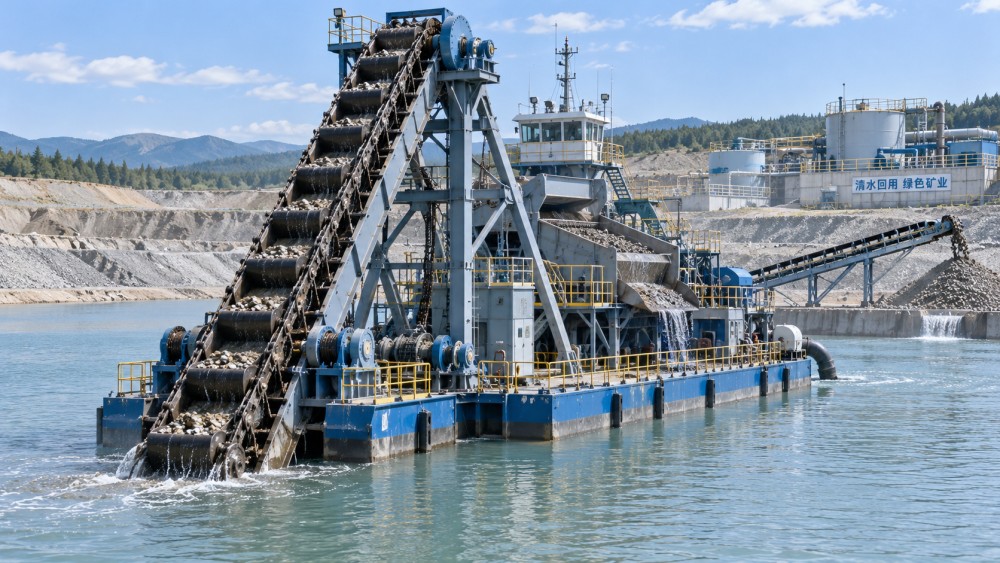
A bucket-chain system uses a circulating chain of buckets to excavate and lift material mechanically. Its suitability depends on how the deposit can be reached and worked, not simply on whether gold or diamonds are present. Mechanical and hydraulic dredging methods have different operating characteristics; equipment selection should follow material conditions and project requirements rather than a universal preference for one method.[2]
Demand becomes more convincing when investigations define the thickness and continuity of the mineral-bearing layer, overburden distribution, excavation depth, and the nature of the underlying surface. Buyers should ask whether the proposed mining sequence can maintain productive excavation without repeatedly moving through barren material or leaving recoverable gravel behind.
Particle-size distribution deserves particular attention. Oversize rocks may interrupt handling or require a separate rejection arrangement. Abrasive gravel can affect bucket, pin, and chain maintenance. Clay-rich material may require more washing or scrubbing downstream. These conditions do not automatically rule out bucket-chain excavation, but they change the specification and the cost assumptions that support procurement.
Evidence should cover the intended mining area rather than one favorable sample location. A supplier cannot reliably translate “alluvial gravel” into an excavation guarantee. Decision-makers should look for investigation records that connect representative ground conditions to the equipment design basis, including known uncertainties and the proposed response if actual conditions differ.
Recovery-plant definition is a stronger signal than nominal dredging capacity
A project can excavate substantial material yet fail commercially if its recovery plant cannot accept or treat that feed. The relevant production measure is not bucket capacity alone. It is the sustainable flow of suitable material through excavation, handling, washing, screening, concentration, and final recovery.
For diamond-bearing gravel, the proposed process must address liberation, size classification, and recovery without assuming that every excavated stone reaches the final product. Gold projects require a flowsheet matched to the occurrence of the gold and the properties of the surrounding material. Similar excavation equipment does not make the downstream processes equivalent.
At the specification stage, a bucket chain diamond dredger can be assessed as part of an integrated excavation-and-processing arrangement rather than as an isolated machine. The commercially meaningful comparison is whether its digging envelope, material-handling interfaces, and proposed processing configuration match the project’s tested feed conditions. A gold/diamond equipment category is a starting point for technical review, not evidence of recovery performance on a particular deposit.
Stronger demand signals include representative processing tests, an agreed feed-size envelope, a plan for oversize handling, and a documented balance between excavation output and plant intake. Buyers should also distinguish bank volume from loose material volume and identify whether quoted throughput includes barren overburden. Otherwise, apparently comparable proposals may describe different production duties.
Acceptance criteria should separate excavation performance from mineral recovery. A dredger may meet its material-delivery obligation while the recovery circuit underperforms for unrelated reasons. Contract interfaces need to identify who owns feed preparation, process testing, sampling, and performance verification.
Site readiness determines whether technical interest becomes an order
A technically suitable deposit can remain commercially inactive if the site cannot support deployment. Water-level variation, access routes, assembly space, power provision, and maintenance facilities all influence whether an equipment proposal can become an operating asset. Each unresolved dependency makes a delivery date less meaningful.
Seasonal constraints are especially important. A project may have adequate water during one period but restricted access or operating conditions during another. Procurement planning should work backward from the usable installation and operating window, allowing for transport, assembly, commissioning, and corrective work. A factory completion date is not the same as a production start date.
Environmental planning is another demand filter. The IFC Environmental, Health, and Safety Guidelines for Mining discuss issues including water management, waste, biodiversity, occupational hazards, and mine closure. These guidelines are a reference for good international industry practice, not a replacement for local law or project-specific approvals.[3]
For market assessment, the stronger signal is evidence that the project has identified its applicable obligations and incorporated them into design, budget, and schedule. A broad statement that permitting is “underway” is less useful than a documented account of unresolved studies, approval dependencies, and operating restrictions.
Environmental requirements may also alter equipment scope. Water-management arrangements, sediment controls, disturbed-material placement, and rehabilitation sequencing can affect site layout and production planning. Buyers should establish these interfaces before comparing quotations; otherwise, the lowest initial price may exclude work needed to operate the project as planned.
Operating economics should explain the buying decision
Credible demand rests on an economic model that connects ground conditions to saleable output. A simple equipment-price comparison misses several costs that may determine whether the project proceeds: mobilization, assembly, energy, wear parts, maintenance labor, process consumables, and downtime.
Availability assumptions require scrutiny. Continuous excavation is a design objective, not a guarantee of uninterrupted production. Chain inspection, bucket repairs, blockages, plant maintenance, and repositioning can reduce productive time. The financial model should distinguish scheduled operating hours from hours in which the full excavation-and-recovery system produces acceptable output.
Wear-part planning provides a useful test of procurement maturity. Buyers should establish which components are expected to wear, how replacements reach the site, which repairs local personnel can perform, and what lifting or workshop facilities are needed. Remote locations can turn an ordinary component replacement into a prolonged stoppage if logistics were omitted from the operating plan.
A practical sensitivity review asks what happens when feed grade is lower than expected, material is harder to excavate, plant recovery falls, or operating availability declines. These are evaluation scenarios, not forecasts. A project that remains workable under reasonable adverse assumptions represents a stronger demand signal than one justified only by its most favorable case.
Rank project signals instead of counting inquiries
A structured review helps commercial teams compare opportunities without implying a statistical market forecast. The following signals are best read together: none independently establishes that an order will be placed.
The combination matters more than an individual checkbox. Funding cannot compensate for an unsuitable excavation method. Strong technical work cannot establish near-term purchasing demand if approvals remain unresolved. A defined operating site does not remove uncertainty about recovery economics.
For manufacturers, this framework can guide engineering effort and production planning. Early-stage projects may need concept options and explicit assumptions; mature projects need interface drawings, delivery commitments, inspection arrangements, and agreed acceptance procedures. For buyers, the same distinction prevents premature supplier selection before the project has a stable design basis.
Watch for changes in procurement maturity, not unsupported growth claims
Without a verified dataset of orders, deliveries, or project expenditure, it would be misleading to assign a growth rate to this equipment category. A more defensible market assessment tracks movement through development stages: which projects complete testing, resolve deployment constraints, define processing interfaces, or authorize capital expenditure.
Changes in inquiry quality can be informative. A request for a general price indicates interest. A request supported by ground data, a process flowsheet, site drawings, and a purchasing schedule suggests a more developed opportunity. The number of requests may rise while their readiness declines, so volume alone can give the wrong impression.
Decision-makers should therefore maintain a project-level view of demand. Record the next unresolved milestone, the evidence needed to pass it, and whether that milestone changes the equipment specification or investment decision. The clearest buying signal is a deposit that supports the method, a recovery circuit that supports the economics, and an organization capable of deploying and operating the complete system.
Sources
- [1] Joint Ore Reserves Committee, Australasian Code for Reporting of Exploration Results, Mineral Resources and Ore Reserves, 2012 Edition. Reference for geological confidence, reporting categories, and modifying factors.
- [2] U.S. Army Corps of Engineers, Dredging and Dredged Material Management, Engineer Manual EM 1110-2-5025. Reference for dredging methods, equipment selection, and project conditions.
- [3] International Finance Corporation, Environmental, Health, and Safety Guidelines for Mining, December 10, 2007. Reference for mining-related environmental management and occupational health and safety considerations.
Related News
- Metals Price Management: Fixed-Price Contracts vs. Hedging for BuyersOct 28, 2026Explore metals price management: compare fixed-price contracts and hedging to protect budgets, manage cash flow, and choose the right strategy for your metal purchases.
- SunSirs: Domestic Praseodymium-Neodymium Prices Decline on October 27Oct 27, 2026Praseodymium-neodymium prices fell on October 27, SunSirs reports. Explore key rare earth quotes and what buyers should check before revising procurement plans.
- Battery-Grade Material Prices: Comparing Quotes by Purity and Delivery TermsOct 20, 2026Compare battery grade materials price quotes by purity, assay basis, and delivery terms. Uncover hidden costs and make smarter sourcing decisions with this practical procurement guide.
- Is Tungsten Trading Still Viable Amid Geopolitical Tensions?Oct 20, 2026Is commodity trading in tungsten still viable given current geopolitical tensions? Explore supply risks, export controls, and sourcing strategies to assess margins and trade with confidence.