
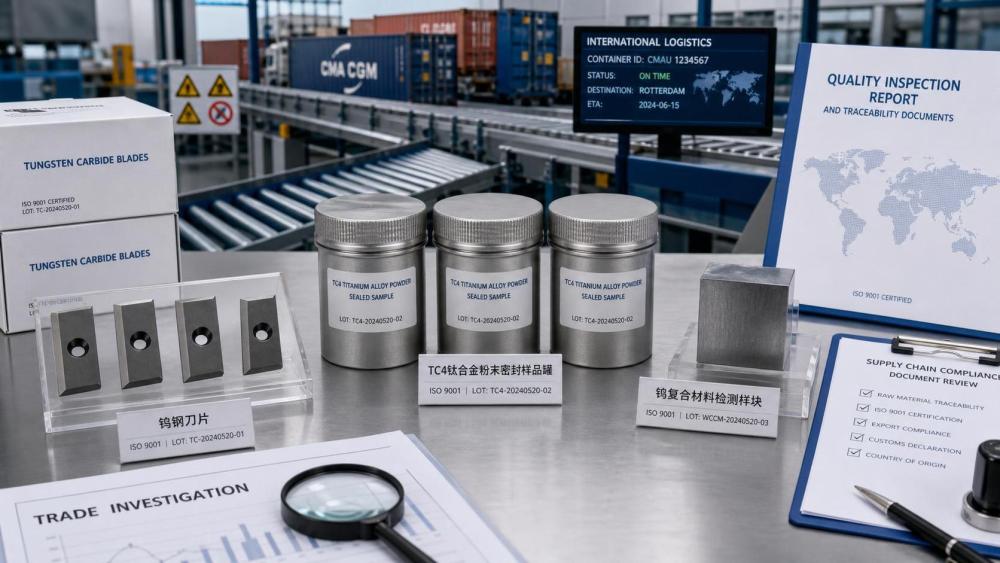
On July 29, 2026, the U.S. Department of Commerce opened an anti-circumvention investigation involving tungsten-containing products from China, with attention on whether third-country transshipment or composition changes were used to avoid additional duties under Section 232. For exporters of Tungsten Carbide Inserts, TC4 Titanium Powders, and tungsten-containing composite materials, this is not only a trade development but also a practical compliance signal affecting customs clearance, supply-chain review, procurement decisions, and delivery planning.
What Has Been Formally Put Under Review
The confirmed facts are limited but clear. The case was formally initiated on July 29, 2026 by the U.S. Department of Commerce. The scope described in the provided information covers Chinese tungsten-containing products, including tungsten-based hard alloy cutting tools and tungsten additives used in TC4 titanium alloy powder. The stated focus is whether third-country routing or product composition restructuring was used to circumvent additional tariffs imposed under Section 232. The event directly affects exporters of Tungsten Carbide Inserts, TC4 Titanium Powders, and tungsten-containing composite materials, while overseas importers are required to reassess supply-chain compliance and customs clearance risk.
Where the Pressure May Appear First in the Supply Chain
Export transactions may face sharper document scrutiny
From an industry perspective, exporters are likely to feel the first impact because the investigation centers on routing and composition. That means transaction records, product descriptions, material declarations, and shipment pathways may receive closer attention in trade processing. What deserves closer attention is whether existing export files consistently describe tungsten content, product configuration, and commercial flow in a way that can withstand review.
Import-side procurement decisions may become more cautious
Overseas importers are explicitly identified in the provided event summary as needing to reassess compliance and clearance exposure. Analysis shows that procurement teams may need to revisit supplier selection, order timing, and shipment structure for affected product categories. The practical issue is not only price exposure, but also whether incoming goods can move through customs without added delay, challenge, or reclassification concerns.
Manufacturing and processing links may need stronger traceability
For manufacturers and processors handling Tungsten Carbide Inserts, TC4 Titanium Powders, or tungsten-containing composite materials, the investigation creates pressure around traceability of composition and processing history. Observably, any business step involving material blending, additive use, or cross-border transfer could become more sensitive from a compliance standpoint. Companies in these links should pay close attention to technical records, batch identification, and supporting material documentation tied to product makeup.
Supply-chain service providers may see higher clearance and coordination risk
Logistics, customs, and related supply-chain service providers may also be affected because the stated review focus includes third-country transshipment. Analysis shows that routing choices, declaration consistency, and handoff between trading parties may become more important operational issues. The main exposure here is execution risk: even without a confirmed final outcome, service providers may need to prepare for stricter review of shipment paths and supporting paperwork.
Immediate Compliance Questions Companies Should Recheck
Review whether product and material descriptions are internally consistent
Because the investigation concerns composition restructuring, companies should closely review whether commercial invoices, technical specifications, material statements, and internal product descriptions align. This should be understood as a compliance review priority rather than proof that any specific documentation standard has already changed.
Reassess third-country routing and transaction structures
Since the stated inquiry includes third-country transshipment, businesses should examine whether current trading arrangements, distribution routes, or intermediary structures could attract additional scrutiny. Observably, this is a point for risk review now, even though the provided information does not define a final enforcement outcome.
Prepare technical and traceability files for affected product lines
For Tungsten Carbide Inserts, TC4 Titanium Powders, and tungsten-containing composite materials, companies should verify that technical files, test-related records, and traceability materials are organized and current. Analysis shows that the practical value of these files is highest when procurement reviews, customs inquiries, or customer due-diligence checks accelerate.
Adjust delivery and purchasing assumptions with caution
Importers and exporters should revisit lead-time expectations, customs risk assumptions, and supplier qualification checks for the product categories named in the event summary. What deserves closer attention is not a confirmed disruption, but the possibility that compliance review and shipment execution could become less predictable while the investigation proceeds.
Why This Looks More Like an Enforcement Signal Than a Closed Outcome
Analysis shows that this development is more appropriately understood as an active enforcement signal rather than a completed rule outcome. The formal initiation of an anti-circumvention investigation indicates that trade authorities are examining how product composition and shipment routing relate to Section 232 exposure. At this stage, the more useful industry reading is that companies should watch how compliance interpretation is applied in practice, especially through customs handling, buyer requirements, and follow-on trade documentation expectations.
How the Industry Should Read the Current Stage
A balanced reading of this event is that it introduces immediate compliance attention without yet providing a fully defined operational endpoint in the information supplied. For the affected product groups and supply-chain participants, the significance lies in the shift from general tariff awareness to specific review of routing and composition practices. It is more appropriate to understand this as a live regulatory development that has already raised practical risk questions, while the final execution approach and market response still require continued observation.
Basis of This Article and What Still Needs Verification
This article is based on the user-provided news title, event date, and event summary. For developments of this kind, commonly relevant source types may include official notices, releases from regulatory authorities, customs or trade administration information, industry association updates, standard-setting documents, and reporting from authoritative media. A specific official source link was not provided in the input, so continued verification remains necessary. Observably, the points that still need close follow-up include any later official wording, enforcement interpretation, customs treatment, procurement document changes, industry feedback, and how affected companies implement compliance reviews in practice.
Related News
- TC4 Titanium Powder Export Readiness Gains PaceAug 11, 2026TC4 Titanium Powder export readiness is accelerating as traceable AS9100/NADCAP-linked data improves buyer audits, sourcing confidence, and faster qualification reviews for aerospace and medical markets.
- U.S. Sets 25% Anti-Dumping Duty on Chinese TC4 PowderAug 07, 2026U.S. sets 25% anti-dumping duty on Chinese TC4 powder, reshaping costs, ASTM F3001-24 compliance, and Nadcap traceability. See what importers and buyers must do now.
- Titanium Alloys Explained: How to Compare Grades for Aerospace and Medical UseAug 06, 2026Titanium alloys explained for aerospace and medical use: compare grades by fatigue, corrosion, manufacturability, compliance, and supply risk to choose the right material with confidence.
- US Tightens Controls on TC4 Powder and Superalloy EquipmentAug 03, 2026US Tightens Controls on TC4 Powder and Superalloy Equipment: learn how new export restrictions may disrupt aerospace supply chains, equipment delivery, and technical cooperation.