
On August 5, 2026, the European Commission released implementing rules under the Critical Raw Materials Act focused on magnetic materials, introducing a new compliance-document requirement for NdFeB permanent magnets imported into the EU from October 1, 2026. For magnet exporters, EV motor supply chains, European automakers, and Tier 1 suppliers, the development is worth close attention because it shifts market access from a product-only discussion toward documented process compliance tied to heavy rare earth diffusion.
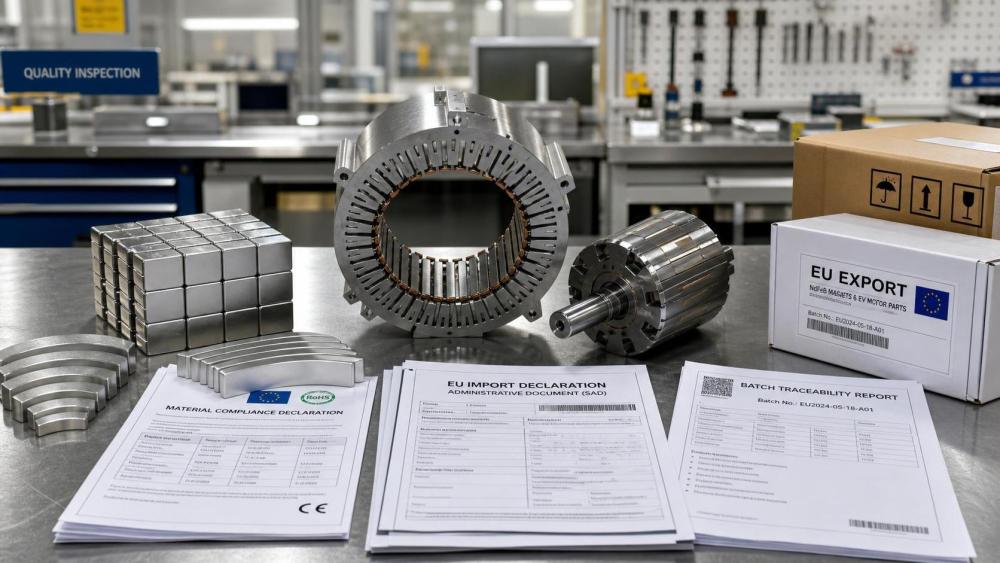
What the new requirement covers
According to the information provided, the new rule applies to all NdFeB permanent magnets imported into the EU, including magnets used in EV motors. From October 1, 2026, these products must be accompanied by a Heavy REE Diffusion process compliance declaration issued by a certification body accredited under ISO/IEC 17065.
The declaration is required to cover the type of diffusion elements used, heat-treatment parameters, verification of grain boundary phase control, and batch traceability. The information provided also indicates that this requirement directly affects the access process for Chinese magnet exporters supplying European vehicle manufacturers and Tier 1 suppliers.
Where the immediate pressure points may appear
Export qualification moves closer to process verification
From an industry perspective, Chinese magnet exporters are likely to feel the most direct impact because the new requirement is tied to entry into the EU market. The practical effect is not limited to shipment paperwork; it also reaches the way exporters prepare compliance records, organize production evidence, and align documentation with customer qualification requirements.
European buyers may face tighter supplier screening
For European automakers and Tier 1 suppliers, the change may affect supplier onboarding and ongoing procurement review. Analysis shows that when a declaration must be issued by an ISO/IEC 17065-certified body and must cover specific process items, procurement teams may need to pay closer attention to whether suppliers can provide complete and timely compliance materials alongside product deliveries.
Supply-chain coordination may become more document-sensitive
For supply-chain service providers and transaction coordinators involved in cross-border deliveries, the issue may extend into order execution and handover timing. What deserves closer attention is whether documentation readiness, batch traceability, and consistency between production records and shipment records become more prominent checkpoints in fulfillment workflows.
What companies should watch before October 1
The gap between rule text and execution practice
Analysis shows that the headline requirement is already clear, but companies should continue monitoring how the declaration is interpreted in actual customer qualification and import procedures. The policy signal and the way it is enforced in contracts, audits, and shipment acceptance may not unfold at exactly the same pace.
Documentation depth around the diffusion process
Companies serving the EU market should focus closely on the specific document scope named in the requirement: diffusion element categories, heat-treatment parameters, grain boundary phase control verification, and batch traceability. These are not generic compliance claims; they point to a more detailed record set that may affect document preparation, internal review, and communication with certification bodies and customers.
Supplier credentials and certification pathways
Observably, supplier qualification will not depend only on the magnet itself, but also on whether the required declaration can be obtained from an ISO/IEC 17065-certified body. Exporters, manufacturers, and procurement teams should therefore pay attention to certification readiness, supporting files, and the time needed to align technical records with third-party issuance requirements.
Customer communication and delivery planning
What deserves closer attention is how this requirement enters commercial execution. Companies involved in EU-facing business may need earlier discussions with customers on document expectations, delivery timing, and batch-level traceability arrangements, especially where access to European OEM or Tier 1 programs depends on uninterrupted qualification status.
Why this looks like more than a short-term paperwork update
Analysis shows that this development is better understood as a compliance signal with practical supply-chain consequences rather than as a routine customs formality. The requirement is specific to process-related evidence, which suggests that market access for NdFeB magnets in the EU is being linked more explicitly to verifiable manufacturing and traceability information.
At the same time, it is more appropriate to understand this as an active regulatory development that still requires continued observation in implementation. The confirmed facts establish the new declaration requirement and its scope, but the broader commercial impact will depend on how buyers, certification bodies, and supply-chain participants apply it in day-to-day transactions.
How to read the development now
For the industry, the immediate significance lies in the fact that a new entry condition has been set for NdFeB magnets going into the EU, with direct relevance for EV motor-related supply chains and for Chinese exporters serving European customers. A neutral reading is that this is not yet a full picture of long-term market restructuring, but it is already a concrete compliance change that companies should treat as operationally relevant before the October 1, 2026 start date.
Basis of this article and what still needs verification
This article is based on the user-provided news title, event date, and event summary concerning the European Commission's August 5, 2026 release of implementing rules under the Critical Raw Materials Act for magnetic materials. For this type of industry development, source categories typically worth tracking include official regulatory notices, company announcements, industry association updates, authoritative media reporting, and standard-related documentation.
A specific official source link was not provided in the input, so the exact underlying document link still needs to be verified on an ongoing basis. Continued attention should be given to any follow-up official wording, implementation clarifications, and how the declaration requirement is applied in supplier access, procurement documentation, and cross-border delivery practice.
Related News
- Does Grain Boundary Diffusion Reduce Heavy Rare Earths in NdFeB Magnets?Sep 10, 2026Does grain boundary diffusion reduce heavy rare earth content in NdFeB magnets? Explore how it boosts coercivity, preserves remanence, and supports high-temperature motor designs.
- How Does Grain Boundary Diffusion Improve Rare Earth Magnets?Sep 03, 2026How does grain boundary diffusion improve rare earth magnet performance? Discover how it boosts coercivity, protects high-temperature stability, and reduces heavy rare earth use.
- China Starts Rare Earth Export Compliance Review for NdFeB Magnets and Heavy REE DiffusionAug 15, 2026NdFeB magnets, Heavy REE Diffusion, and China’s Aug. 14 export compliance review are reshaping rare earth supply chain rules—see what it means for EV procurement and certification.
- EU Tightens NdFeB Magnet Import DeclarationsAug 06, 2026EU Tightens NdFeB Magnet Import Declarations: discover how the new EU compliance rule affects EV motor supply chains, exporters, and automakers before the October 1, 2026 deadline.