
Wrought aerospace superalloys sit at the center of high-temperature design decisions. They are used where strength, creep resistance, and fatigue life must survive heat, load, and time together.
That sounds straightforward, but real material selection is rarely simple. Grade choice depends on temperature window, forming route, machining limits, certification needs, and supply continuity.
Across aerospace and broader advanced manufacturing, this is why wrought aerospace superalloys receive so much attention. They connect metallurgy, process control, and commercial risk in one material family.
For technical research, it helps to move past generic alloy labels. The useful question is where each wrought grade fits, and where it stops being the right answer.
What exactly makes wrought aerospace superalloys different?
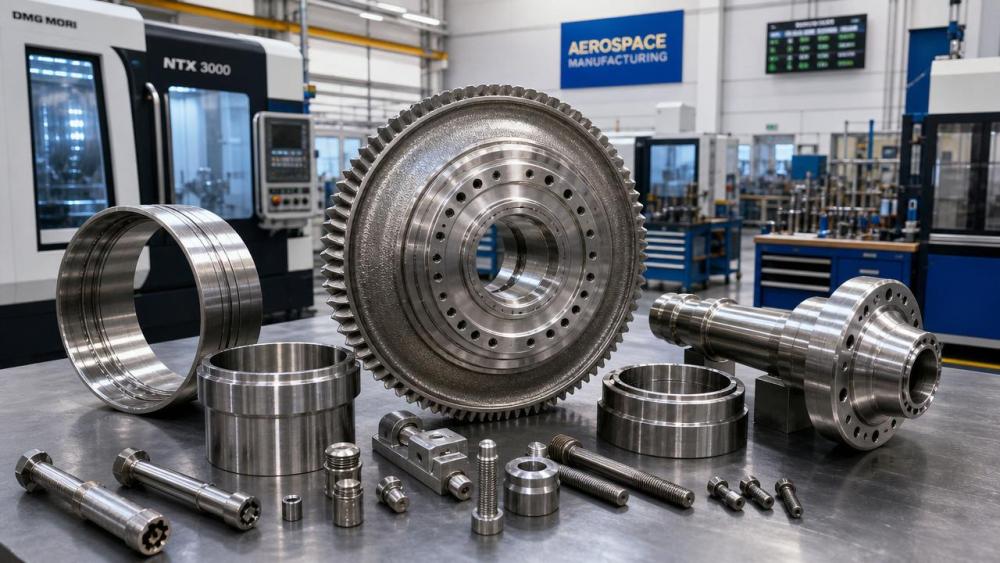
In simple terms, wrought aerospace superalloys are high-performance alloys shaped by forging, rolling, extrusion, or other deformation processes before final heat treatment.
Most are nickel-based, although some iron-nickel and cobalt-containing systems also appear in aerospace service. Their defining job is to keep mechanical integrity at elevated temperature.
The word “wrought” matters because processing changes grain structure, cleanliness, and consistency. That usually gives better toughness, fatigue behavior, and property uniformity than many cast forms.
Cast superalloys still matter, especially for complex turbine shapes. Yet wrought aerospace superalloys are often preferred for discs, shafts, rings, fasteners, sheet, and structural hot-section parts.
AAMS often frames materials through both technical and supply-chain logic. That approach suits this topic well, because performance data alone never tells the whole selection story.
Which grades appear most often, and where do they usually fit?
Search interest around wrought aerospace superalloys usually starts with grade names. The challenge is that grades overlap, but their best-fit applications are not identical.
A quick comparison helps before digging into specifications, AMS standards, or heat-treatment details.
In practice, Inconel 718 is often the entry point because it balances strength, availability, and process familiarity. It is widely studied and relatively easier to source.
Waspaloy and Rene 41 move the conversation upward in temperature capability. That usually brings tighter process windows, more difficult fabrication, and closer attention to heat-treatment control.
For sheet or combustion-facing parts, oxidation resistance can matter as much as raw tensile strength. That is why alloys like Haynes 230 or Alloy X keep showing up.
How do engineers judge whether a wrought grade is actually suitable?
The first filter is not ultimate tensile strength. More often, the real filter is the combined effect of service temperature, time at temperature, cyclic loading, and environment.
For wrought aerospace superalloys, a good evaluation usually includes these questions:
- Does the alloy keep creep strength for the required life, not just short-term test values?
- How stable is the microstructure after long exposure near service temperature?
- Will low-cycle fatigue or dwell fatigue control failure risk?
- Is oxidation, sulfidation, or hot corrosion part of the operating environment?
- Can the part be forged, machined, joined, and inspected without excessive yield loss?
This is where many comparisons become more practical. A stronger alloy on paper may lose value if it creates machining bottlenecks or inconsistent forged structure.
Another useful check is geometry. Thick discs, thin sheet, rings, and fasteners do not ask the same thing from wrought aerospace superalloys, even under similar temperatures.
AAMS often connects alloy behavior with thermodynamics, heat treatment, and compliance readiness. That broader lens is important when material selection affects qualification timelines.
Where do wrought aerospace superalloys outperform cast alternatives, and where do they not?
A common search question is whether wrought aerospace superalloys are simply “better” than cast superalloys. The short answer is no. They are better for different reasons.
Wrought forms usually win where toughness, fatigue resistance, and structural consistency matter most. Rotating parts are the obvious example because defect tolerance is critical.
Cast forms often win where shape complexity dominates. Turbine blades and vanes need internal cooling passages that are not realistic through wrought processing alone.
There is also a temperature logic. Some of the most extreme hot-section environments rely on directionally solidified or single-crystal cast materials, not wrought aerospace superalloys.
So the comparison should focus on component function, not alloy prestige. If the part must rotate safely for long cycles, wrought often has the edge.
If the part needs intricate cooling geometry at very high gas temperatures, cast routes may be the real fit. That is a design choice, not a quality ranking.
A quick decision table for early screening
What are the biggest mistakes when comparing wrought aerospace superalloys?
One frequent mistake is reading room-temperature strength as the deciding metric. Aerospace service rarely rewards that shortcut, especially in creep-limited environments.
Another mistake is treating all wrought aerospace superalloys as equally available. Melting route, billet size, forging capacity, and certification history can all shift delivery risk.
Heat treatment is another blind spot. A grade may look familiar, yet different solution and aging routes can change grain size, precipitation behavior, and final performance.
It is also easy to overlook downstream processing. Some grades machine slowly, distort during thermal cycles, or require tighter non-destructive inspection control.
- Do not compare datasheets without matching product form.
- Do not assume aerospace alloy names guarantee identical standards coverage.
- Do not separate metallurgical performance from qualification and supply-chain evidence.
This is why intelligence platforms such as AAMS matter in the wider industry context. They connect material science with certification, sourcing, and application interpretation.
How should early-stage research narrow the shortlist?
A practical shortlist starts with application conditions, not brand recognition. Write down the real temperature range, hold time, load type, geometry, and atmosphere first.
Then compare wrought aerospace superalloys using a narrower lens. That usually produces faster and more realistic decisions than collecting every possible nickel-based grade.
A useful screening sequence looks like this:
- Define maximum temperature and sustained exposure time.
- Separate creep-limited parts from fatigue-limited parts.
- Match the alloy to product form such as bar, ring, plate, or sheet.
- Check processing route, inspection requirements, and heat-treatment maturity.
- Review supply depth, lead time sensitivity, and standards traceability.
For broader industrial readers, this matters beyond aerospace alone. Similar thinking also supports energy, defense, high-performance tooling, and other heat-critical systems.
The value of wrought aerospace superalloys is not just their chemistry. It is the full package of process discipline, application fit, and predictable long-term performance.
So, where do wrought aerospace superalloys fit best today?
They fit best where high temperature meets structural duty, and where failure tolerance is low. Engine discs, shafts, rings, fasteners, combustor hardware, and hot structures remain core examples.
The most useful takeaway is that wrought aerospace superalloys are not one category with one answer. Grade, form, process route, and operating window all reshape the decision.
When reviewing options, focus on creep behavior, fatigue mode, oxidation resistance, manufacturability, and certification evidence together. That gives a more reliable picture than strength data alone.
As a next step, build a simple comparison sheet around service temperature, product form, processing route, and supply risk. That approach usually reveals which wrought aerospace superalloys deserve deeper evaluation.
Related News
- Nickel-Cerium Alloy Selection Criteria for High-Temperature Aerospace ComponentsSep 11, 2026Nickel cerium alloys boost thermal stability & oxidation resistance in jet engine hot sections—discover key selection criteria for aerospace reliability.
- Alloy Characterization Methods: Choosing Tests for Aerospace Material QualificationSep 11, 2026Alloy characterization methods for aerospace qualification: select chemistry, microstructure, mechanical, NDT, and environmental tests that prove service-ready performance.
- Non-Ferrous Alloy Applications: Matching Materials to Aerospace, EV, and Marine LoadsSep 10, 2026Non-ferrous alloy applications for aerospace, EV, and marine loads: compare aluminum, titanium, nickel, copper, and magnesium for durable, verified material choices.
- Which Corrosion Resistance Standards Apply to Aerospace Metals and Coatings?Sep 09, 2026Corrosion resistance standards for aerospace metals and coatings: compare ASTM, MIL, ISO, and qualification requirements for reliable, compliant performance.