
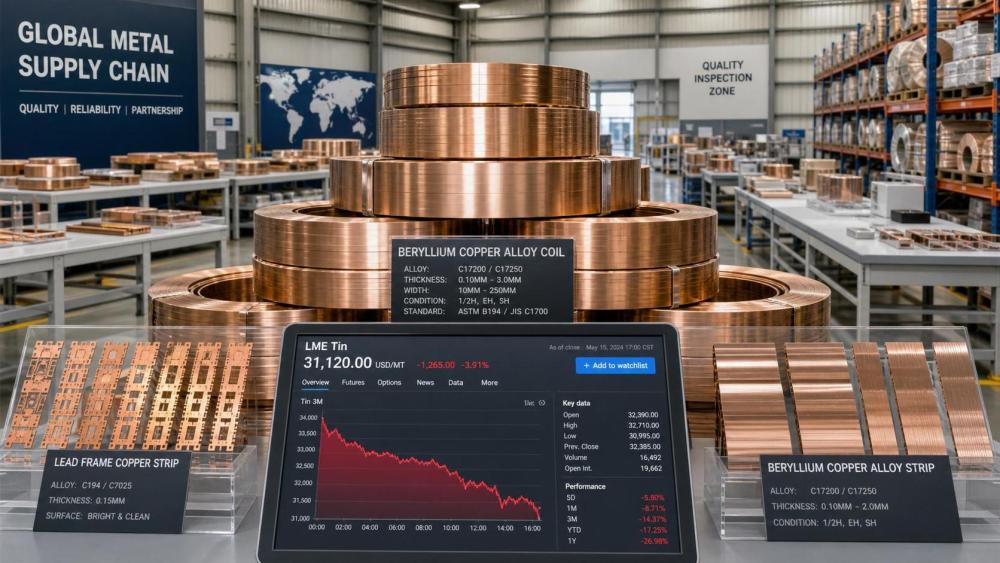
On June 23, 2026, the sharp intraday drop in LME tin prices became more than a price story for the materials supply chain. The move followed a correction in overheated expectations around so-called computing-related metals after public scrutiny, alongside a slower order rhythm in advanced packaging, and it is now affecting how overseas quotations, quarterly purchasing plans, and inventory discipline are being handled for high-end lead-frame materials such as Beryllium Copper Alloys and Lead Frame Cu Strips. For traders, buyers, processors, and distributors, the development is worth watching as a market signal that may influence pricing references, purchasing execution, and supply-chain risk controls.
What the market confirmed on June 23
The confirmed facts are limited but clear. On June 23, 2026, LME tin fell 3.98% during the day to USD 52,100 per ton. The movement was linked to a correction in prior overheating expectations around computing-related metals after they were publicly called out, while the pace of advanced packaging orders also slowed. The immediate impact described in the event summary is on overseas quotation anchoring and quarterly procurement adjustments for high-end lead-frame materials including Beryllium Copper Alloys and Lead Frame Cu Strips, with distributors recalibrating safety-stock levels.
Why this matters across the transaction chain
Quotation practices are under fresh pressure
For direct trading companies and export-facing sellers, the main issue is not only the metal price decline itself but the stability of the pricing reference used in quotations. Analysis shows that when a benchmark moves sharply in a short period, counterparties may revisit offer validity, adjustment clauses, and the timing of quotation confirmation. What deserves closer attention is whether procurement and sales teams need tighter internal controls over pricing windows, document consistency, and customer communication before confirming orders.
Quarterly purchasing plans may need recalibration
For raw-material buyers and procurement teams serving high-end lead-frame applications, the reported adjustment to quarterly purchasing plans points to a practical execution issue. From an industry perspective, a sudden change in benchmark sentiment can affect purchasing cadence, lot sizing, and the balance between spot replenishment and planned orders. Companies in this position may need to pay closer attention to how procurement schedules, supplier confirmation records, and delivery commitments are aligned when the underlying reference becomes less stable.
Distributors face inventory and delivery coordination risks
For channel distributors and supply-chain service providers, the event summary specifically notes a recalibration of safety-stock levels. Observably, this places operational focus on inventory thresholds, replenishment timing, and delivery matching. The rule-related implication here is practical rather than legislative: once market participants reset stock assumptions, the pressure can shift to order allocation, shipment timing, and documentary accuracy in transactions that depend on benchmark-linked pricing.
Processors must watch customer-side specification execution
For processors and manufacturers using Beryllium Copper Alloys or Lead Frame Cu Strips, the impact may appear through the commercial side before it shows up in production. Analysis shows that when overseas quotation anchoring changes, downstream customers may revisit procurement timing, release schedules, or bid documentation assumptions tied to material cost references. That means technical and commercial files may need closer coordination so that delivery and specification execution remain consistent if purchasing behavior turns more cautious.
What companies should review now
Recheck how quotations are referenced and approved
Analysis shows that companies should closely review whether internal quotation approval flows, benchmark reference dates, and offer-validity language remain fit for a more volatile pricing environment. This is especially relevant where overseas quotations rely on externally observed metal benchmarks.
Track procurement paperwork against timing changes
Where quarterly purchasing plans are being adjusted, what deserves closer attention is the consistency between purchase orders, supplier confirmations, delivery schedules, and any technical or commercial attachments used in transactions. The event summary does not confirm any formal rule change, so this should be treated as a precautionary review rather than a settled execution requirement.
Watch inventory policy and supplier coordination
Observably, the recalibration of safety stock suggests that distributors and buyers may need to revisit internal inventory thresholds and supplier communication routines. The practical issue is whether stock policy, shipment planning, and replenishment decisions still match current order rhythm and quotation behavior.
Continue monitoring market language and execution signals
From an industry perspective, companies should also watch for any follow-on changes in market wording, procurement requirements, bid documents, or customer-side execution standards. Based on the provided facts, no confirmed new regulatory text, certification rule, or official trade measure has yet been identified in the input, so ongoing monitoring remains more important than assuming a completed rule shift.
How this signal is best understood for now
Analysis shows that this development is better understood as an execution signal than as a confirmed new regulatory framework. The combination of public scrutiny around computing-related metals and slower advanced packaging order rhythm has already affected price anchoring and procurement behavior, but the current information does not establish a formal new policy, certification requirement, or trade rule in force. What deserves closer attention is how buyers, sellers, and distributors translate this signal into procurement discipline, documentation practice, and inventory control over the coming cycle.
A cautious reading of the immediate impact
At this stage, the event points to a market-led adjustment in pricing references and purchasing behavior for selected high-end lead-frame materials rather than a completed structural change in rules. A rational reading is that affected companies should treat the move as a prompt to review quotation discipline, procurement timing, supplier coordination, and delivery risk, while avoiding over-interpretation before clearer execution patterns emerge.
Basis of this article and what still needs verification
This article is based on the user-provided news title, event date, and event summary. For developments of this type, relevant source categories typically include official announcements, regulatory releases, customs or trade authority information, industry association updates, standard-setting documents, and reporting from authoritative media. No specific official source link was provided in the input, so any later interpretation still requires continued verification. What remains important to monitor includes possible changes in policy detail, certification interpretation, bidding documents, industry feedback, and how companies actually implement procurement and inventory adjustments in response to the signal.
Related News
- How to Compare High-Conductivity Conductive Alloys for Electrical ComponentsSep 02, 2026High conductivity conductive alloys compared for electrical components—evaluate strength, heat resistance, contact reliability, and manufacturability to select the right material.
- How to Select High Conductivity Beryllium Copper for Connectors and SpringsJul 27, 2026High conductivity beryllium copper selection for connectors and springs: learn how to balance conductivity, spring force, stress relaxation, and reliability for better design decisions.
- EU REACH Rule Takes Effect for BeCu SVHC ReportsJul 14, 2026EU REACH Rule takes effect for BeCu SVHC reports, requiring real-use exposure assessments for EU imports. See who is affected, customs risks, and how to prepare compliance now.
- How to Choose Copper Alloys for Busbars: Conductivity, Strength, and Cost Trade-OffsJul 12, 2026Copper alloys for busbars: learn how to balance conductivity, strength, and total cost. Compare key alloy options and choose the best fit for reliable, efficient power systems.